Your competitors aren't working harder. They're working with more capacity.
Most growing companies don't lose to competitors with better products. They lose to competitors with more capacity to act on the same opportunities. Here's what they're doing differently — and how you can close the gap without increasing your overhead at the same rate.
The most successful companies operating globally today aren't necessarily better at their core business than you are. They are not smarter, better funded, or more talented across the board.
They have made one structural decision that changed what they're able to do.
Instead of building more management layers, hiring more local employees at the same cost base, and stretching their existing teams to the breaking point — they built flexible global execution capacity. And that capacity is what lets them respond faster, serve more clients, improve follow-up, and pursue opportunities that companies without that infrastructure simply can't act on quickly enough.
"The problem for most growing businesses is not a lack of opportunity. It is a lack of capacity to act on it."
The traditional choice no longer fits
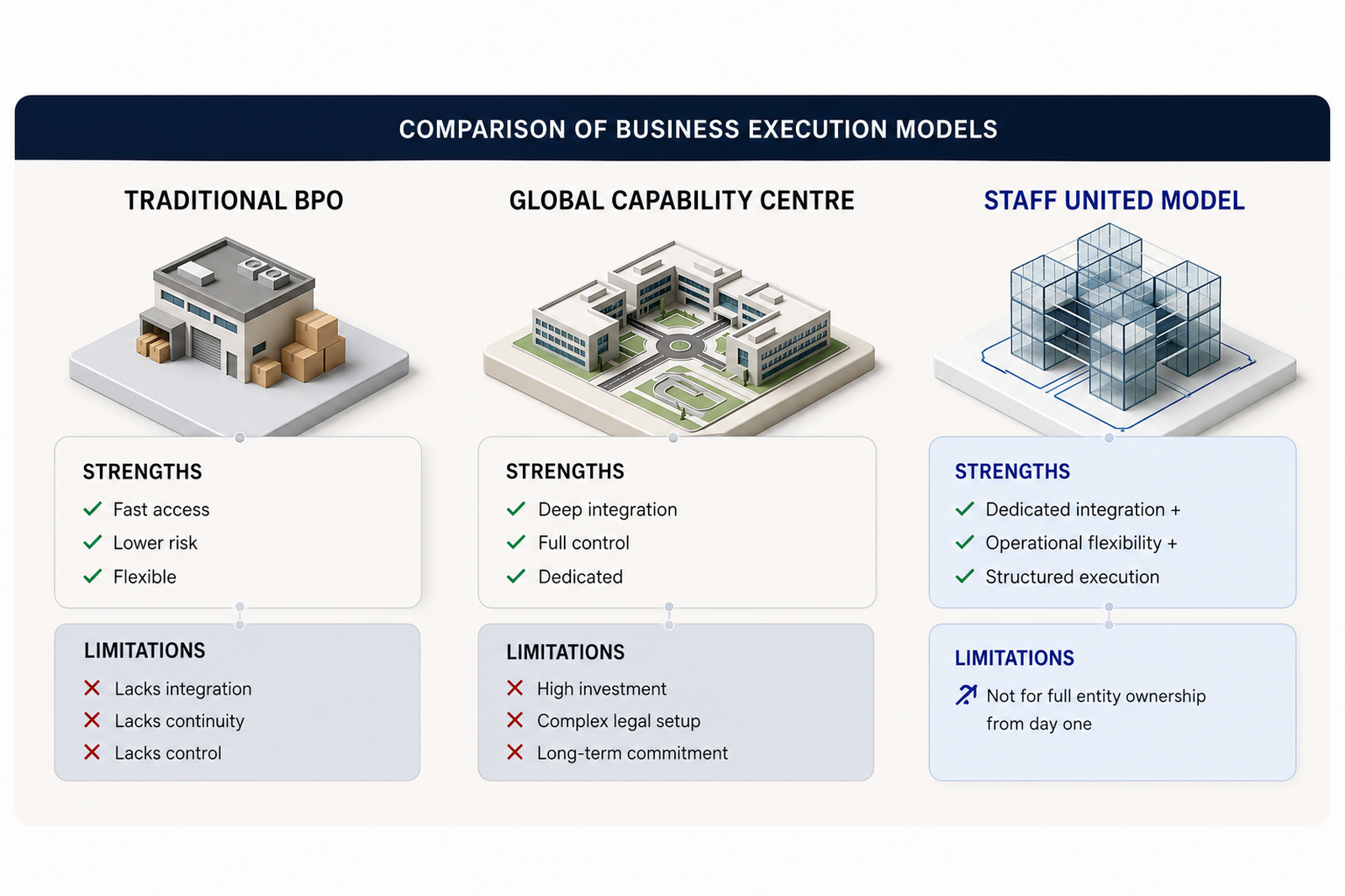
For decades, companies looking to build international capacity faced a binary choice. A Business Process Outsourcing provider — a BPO — offered flexibility, faster access to talent, and lower setup risk. But traditional outsourcing often lacked the integration, continuity, and operational control that growing companies actually need.
The alternative was a Global Capability Centre — a GCC — which gave a company its own dedicated overseas operation, deeper integration, and greater control. But it also required significant investment, local infrastructure, legal entity setup, HR systems, compliance management, and a long-term commitment that felt heavy for a company still testing its international ambitions.
The problem with both options is that they were designed for companies operating at scale, not for companies building toward it.
The space between
STAFF United operates in the space between these two models — and that positioning is deliberate, not incidental.
We provide the local recruitment, employment infrastructure, administration, compliance support, and operational systems associated with traditional outsourcing. At the same time, we build dedicated execution teams that become closely integrated into each client's business, systems, workflows, and long-term goals.
The result is a model that gives companies something neither the traditional BPO nor the GCC route offers cleanly.
It's not about labour cost. It never was.
The companies that approach global expansion purely as a cost-reduction exercise usually find that cheap is actually expensive when it lacks reliability, structured accountability, and genuine integration into how the business operates.
The real value of a well-structured global execution team is not what it saves. It's what it makes possible.
A properly built global team can support more clients without the same proportional increase in senior headcount costs. It can improve follow-up and service consistency — the areas where most growing businesses quietly lose clients they should have kept. It can strengthen the systems and workflows that currently depend on people who shouldn't be spending their time on them. And it can free your most experienced people to do the work only they can do.
"The question isn't whether you can afford a global execution team. It's whether your current operating model is giving your business enough room to compete."

A smarter path into Vietnam
Vietnam in 2026 is not the market it was five years ago. The talent pool has matured significantly across administration, marketing, finance, and operations. The professional infrastructure — tools, communication norms, international-facing workflows — has developed to the point where well-structured Vietnam-based teams can operate as genuine extensions of international businesses, not lower-quality alternatives to them.
But companies don't need to build a complete overseas operation to access that talent and infrastructure. They can begin with STAFF United, develop their workflows, test the available talent, measure performance against their own standards, and determine whether Vietnam is the right long-term market for their capacity needs — before committing to the full complexity of establishing their own overseas entity.
Some companies will eventually establish their own GCC. Others will find that the STAFF United model already gives them the integration, control, and capacity they need — without the cost and management overhead of owning the full operation.
That's the best of both worlds. And it's available now.
What your next step looks like
The companies currently outpacing you in capacity aren't working harder than your team. They've made one structural decision that gave them more room to act — and they made it before the opportunities were obvious.
If your business is growing but your ability to serve more clients, execute more consistently, and pursue new opportunities isn't keeping pace — the question worth asking is whether your current structure was built for the scale you're heading toward, or the scale you're coming from.
Related Insights
Uncovering the True Cost of Offshore Execution: Hourly Rates vs. Total Cost of Execution
How global operators evaluate financial transparency, eliminate hidden fees, and build predictable offshore capacity in Vietnam.
The Turnover Trap: How Disorganized SOPs Drain Your Business Continuity
Why traditional offshore models lose operational knowledge during team turnover—and how embedded process architecture protects your business.

Cultural Synergy in Global Teams: How Modern Vietnamese Professionals Master Executive Communication
How international founders overcome cultural friction, build direct feedback loops, and unlock proactive execution in Vietnam.