The Turnover Trap: How Disorganized SOPs Drain Your Business Continuity
Why traditional offshore models lose operational knowledge during team turnover—and how embedded process architecture protects your business.
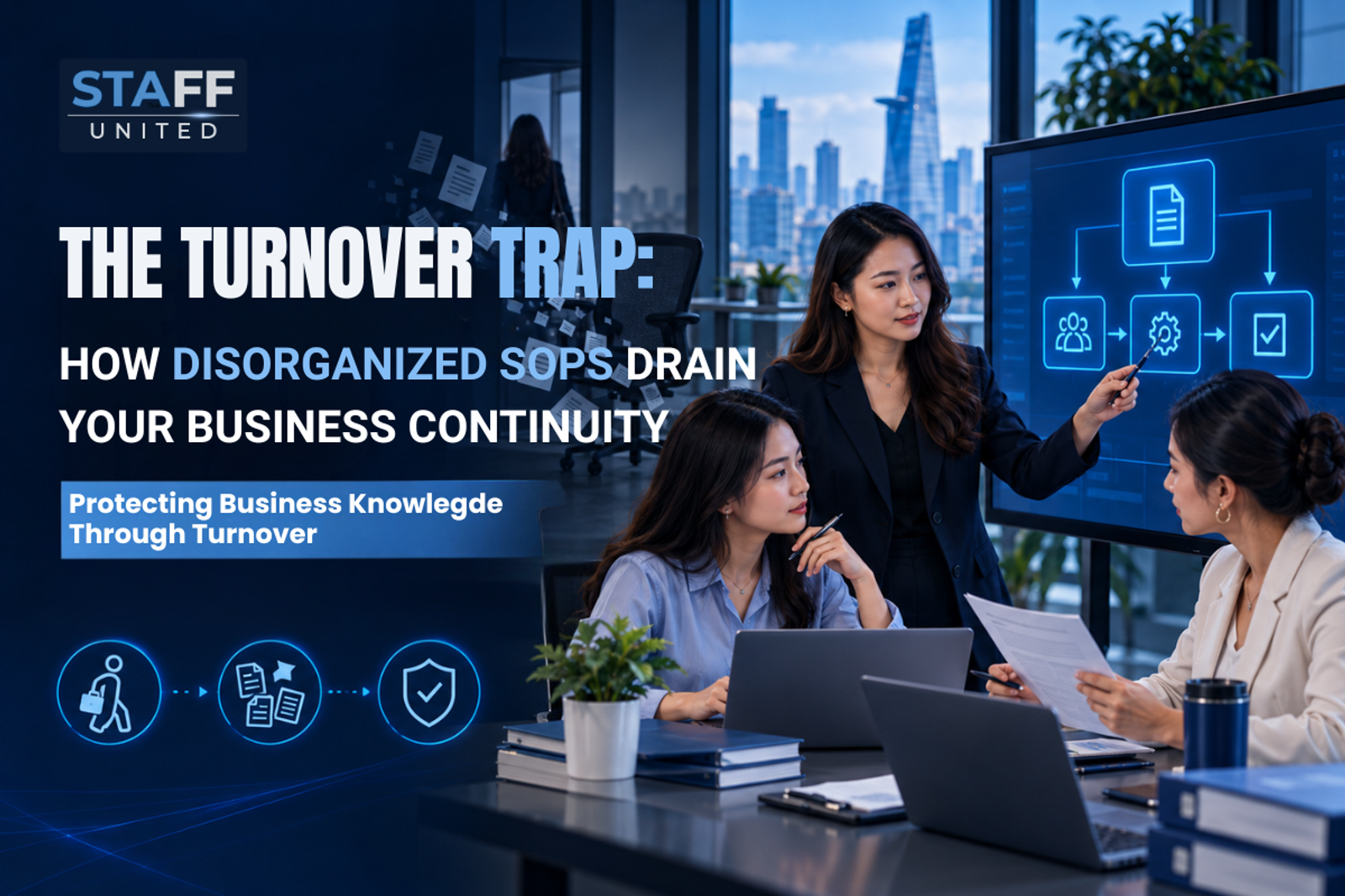
Key Takeaway: Talent turnover isn’t just an HR problem; it’s an operational continuity risk. When your execution relies on individual memory rather than structured, system-level SOPs, every resignation resets your growth velocity back to zero.
When scaling global operations, business leaders typically evaluate obvious metrics: hourly rates, technical skill sets, and time zone alignment.

However, one of the most damaging hidden risks in global staffing often goes overlooked until it is too late: Operational Knowledge Loss due to Turnover.
In many growing companies, daily workflows are kept in a chaotic state:
- Critical tasks live inside the heads of individual staff members rather than documented systems.
- Standard Operating Procedures (SOPs) are either outdated, fragmented across personal Google Docs, or non-existent.
- Onboarding a new team member takes weeks of repetitive, one-on-one video calls and hand-holding.
When an employee or contractor departs, they don't just leave a vacant seat—they walk away with your operational blueprint. Your internal team is then forced to pause strategic initiatives to retrain a replacement from scratch.
Comparing Workforce Models: Who Owns Your Process Knowledge?
How your business preserves operational knowledge depends entirely on the workforce framework you deploy:
1. Freelancers & Marketplaces (Maximum Knowledge Loss)
Freelancers work independently on personal workflows. When a freelancer leaves or becomes unavailable, your institutional knowledge disappears overnight, leaving your internal team with zero documentation.
- The Continuity Risk: Extreme. High dependency on individual availability with zero structural retention.
2. Traditional BPO / Vendor Outsourcing (The High-Attrition Black Box)
Traditional BPO hubs suffer from industry-wide attrition rates often exceeding 30–40% annually. Because work is passed behind a vendor "black box," you rarely control how SOPs are maintained.
- The Continuity Risk: High. You constantly experience quality dips as rotating, non-dedicated staff take over your account without deep context.
3. Foreign Entity / GCC (High Control, High Maintenance)
Building a Global Capability Centre allows you to enforce centralized documentation, but your executive team carries 100% of the burden for setting up, auditing, and maintaining local HR systems.
- The Continuity Risk: Low risk of knowledge loss, but extremely high administrative overhead for your leadership team.
Building Process-First Architecture: Protecting Your Operating System
To escape the turnover trap, global execution must be built on System-Level Process Ownership rather than individual memory.
A resilient global execution engine operates on three core principles:
- Centralized Tech Stack Ownership: All SOPs, video walkthroughs, and workflow logic must live directly inside your internal cloud ecosystem (Notion, Slack, Asana, HubSpot)—never in private local folders or vendor-owned portals.
- Living SOP Culture: Workflows are treated as active, evolving assets. Every execution task is linked to a clear, step-by-step procedure that is continuously updated as tools and goals evolve.
- Plug-and-Play Redundancy: When processes are standardized at the system level, onboarding a new team member becomes a seamless plug-and-play transition rather than an operational crisis.
The STAFF United Perspective: Embedded Teams Built for Process Continuity
At STAFF United, we believe your operational knowledge is your most valuable asset. We don't just provide execution capacity; we safeguard your business continuity.

Here is how the STAFF United Model protects your operational knowledge:
- Embedded System Access: Your dedicated team executes tasks directly inside your SaaS platforms, ensuring 100% of documentation, data, and workflows remain your permanent property.
- Structured Operational Pillars: Supported across our 5 operational pillars (Strategic Operations, Targeted Sales, Accounting & Legal Support, Focused Marketing, and Business Support), our teams operate under strict SOP adherence and standardized reporting protocols.
- High Retention & Institutional Discipline: Based in Vietnam's vibrant tech ecosystem, our all-women execution teams bring exceptional loyalty, professional discipline, and long-term commitment—drastically reducing attrition and protecting your operating momentum.
👉 Ready to protect your operational continuity?
Head to staffunitedgroup.com/request-support to complete our 5-minute Client Fast Track and tell us which operations you’re ready to delegate today.
Related Insights
Uncovering the True Cost of Offshore Execution: Hourly Rates vs. Total Cost of Execution
How global operators evaluate financial transparency, eliminate hidden fees, and build predictable offshore capacity in Vietnam.
Cultural Synergy in Global Teams: How Modern Vietnamese Professionals Master Executive Communication
How international founders overcome cultural friction, build direct feedback loops, and unlock proactive execution in Vietnam.
Data Security and IP in Vietnam: How to Safely Scale Offshore Operations Without Risking Your Assets
How modern enterprises protect proprietary data, CRM systems, and intellectual property when building dedicated global execution teams.