Data Security and IP in Vietnam: How to Safely Scale Offshore Operations Without Risking Your Assets
How modern enterprises protect proprietary data, CRM systems, and intellectual property when building dedicated global execution teams.
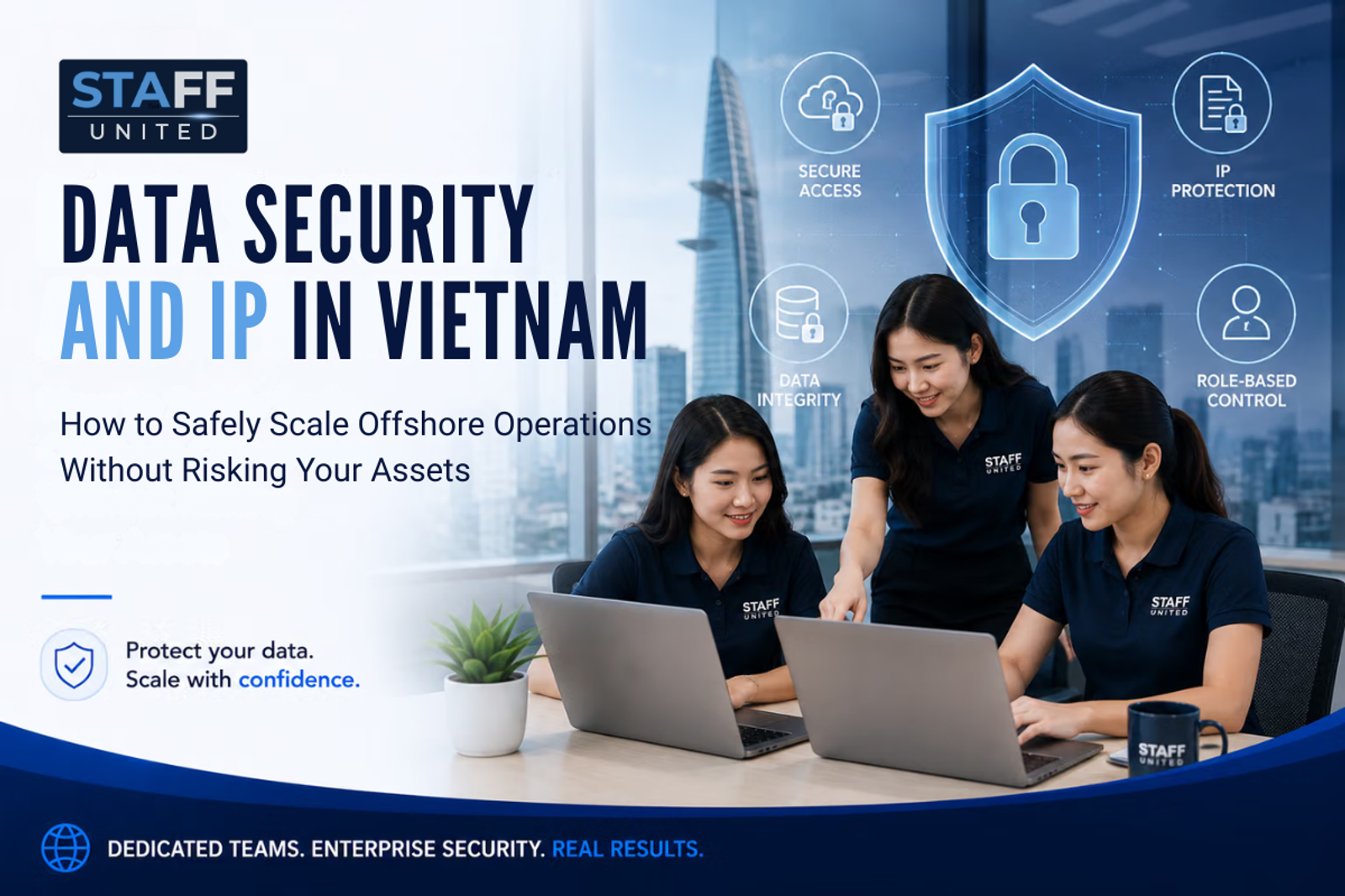
Key Takeaway: Data security in global staffing isn't about where your team sits physically—it is determined by how access is structured. By shifting from third-party data handoffs to system-level access control, companies can safely build high-capacity offshore teams in Vietnam without exposing intellectual property or sensitive client data.
When business leaders consider expanding their execution capacity globally, financial and operational metrics usually look compelling. However, as the conversation moves toward execution, a critical hesitation emerges: Data Security and Intellectual Property (IP) Protection.

Operational leaders ask the tough questions before handing over system access:
- "How do we prevent sensitive client records or financial data from being leaked?"
- "If an offshore team member leaves, who retains ownership of the workflows and documentation they built?"
- "What legal framework protects our proprietary processes and intellectual property when working in Vietnam?"
These are essential questions. Protecting core assets is non-negotiable. Yet, many global founders hold back from scaling because they conflate location risk with access management risk.
Comparing Workforce Models Through a Security Lens
Different workforce expansion models handle data security, system access, and legal accountability in fundamentally different ways:
1. Freelance Networks (High IP & Security Risk)
Hiring individual freelancers exposes your business to maximum security vulnerabilities. Work is often executed on personal, unmonitored hardware without centralized administrative control or enforceable cross-border legal contracts.
- Security Flaw: High risk of data leakage, zero continuity, and no institutional accountability if a freelancer disappears with proprietary files.
2. Traditional BPO / Outsourcing (Opaque Data Handling)
In traditional BPO setups, work is passed behind a black box. You hand over raw data or task batches to a vendor, who then distributes the work across rotating, non-dedicated staff.
- Security Flaw: You lose visibility over who is handling sensitive information. Data moves through third-party servers and middle-management layers rather than staying strictly within your internal tech stack.
3. Foreign Entity / GCC (Maximum Control, High Overhead)
Establishing a local subsidiary (Global Capability Centre) gives you complete legal and physical infrastructure ownership.
- Security Flaw: While highly secure, building a GCC requires months of corporate registration, local legal retainer fees, and massive upfront capital expenditure just to secure basic compliance.
The Modern Security Standard: System-Level Access Control
The modern enterprise tech stack has fundamentally changed how global security operates. You no longer need to send sensitive files back and forth over email or third-party portals.
Leading global companies enforce a System-Level Access Control methodology when integrating offshore execution capacity:
- Native SaaS Environment Execution: Teams work inside your existing enterprise platforms (HubSpot, Salesforce, Notion, Xero, Slack) using single-sign-on (SSO) and role-based permissions (RBAC).
- Zero Local Storage Policies: Global staff execute work directly in cloud environment dashboards without downloading sensitive databases onto local machines.
- Revocable Access Offboarding: If a team structure changes, revoking system access takes one click from your central IT dashboard—instantly cutting off access to all internal communications and files.
The STAFF United Perspective: Embedded Execution with Enterprise Security
At STAFF United, we designed our staffing model to give international founders total peace of mind regarding data integrity and IP protection.

Here is how the STAFF United Model safeguards your operational assets:
- Direct System Access: Your dedicated team works directly within your security perimeter, using your company domain emails, permission levels, and security standards.
- Robust Legal Protection: Every engagement is backed by clear international service agreements, comprehensive Non-Disclosure Agreements (NDAs), and strict IP assignment clauses ensuring 100% of created assets remain your exclusive property.
- Dedicated Operational Continuity: Based in Ho Chi Minh City, our highly skilled execution teams operate under structured internal management across five core pillars—ensuring high accountability, low turnover, and zero operational data leakage.
👉 Ready to expand your execution capacity with total data confidence?
Launch your 5-minute Client Fast Track at staffunitedgroup.com/request-support and show us which workflows you need offloaded today.
Related Insights

Uncovering the True Cost of Offshore Execution: Hourly Rates vs. Total Cost of Execution
How global operators evaluate financial transparency, eliminate hidden fees, and build predictable offshore capacity in Vietnam.
The Turnover Trap: How Disorganized SOPs Drain Your Business Continuity
Why traditional offshore models lose operational knowledge during team turnover—and how embedded process architecture protects your business.

Cultural Synergy in Global Teams: How Modern Vietnamese Professionals Master Executive Communication
How international founders overcome cultural friction, build direct feedback loops, and unlock proactive execution in Vietnam.