Why We Built STAFF United: The Execution Gap We Kept Seeing
This blog isn't a traditional founder biography or a standard corporate origin story. This is a clinical analysis of the structural market flaw that made the creation of STAFF United completely non-negotiable.
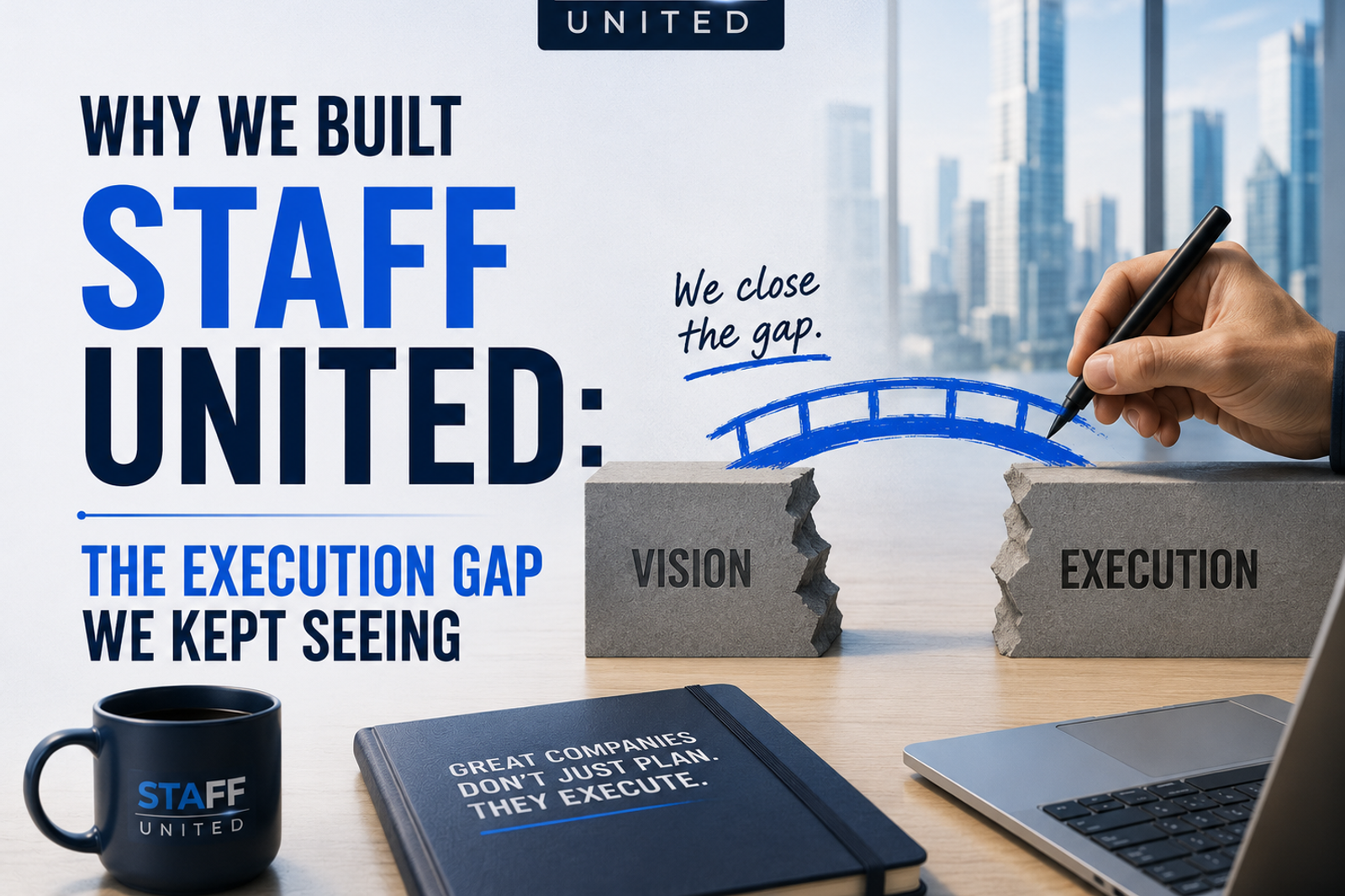
For years, the venture capital ecosystem, technology incubators, and business accelerators focused almost entirely on the front end of entrepreneurship. Founders were told to relentlessly obsess over product-market fit, capital fundraising rounds, and aggressive user acquisition metrics.
But as the global digital landscape matured, an entirely different bottleneck emerged.
The ultimate failure point for modern enterprises is rarely a lack of vision, capital, or market opportunity. It is a failure of execution infrastructure. When a high-growth company begins to slip on its timelines, drown in administrative overhead, or deliver inconsistent results to its clients, the root cause isn't a lack of executive talent at the top. It is a missing layer of operational scaffolding underneath.
1. The Market Problem That Made STAFF United Necessary
When we looked across the global landscape, we repeatedly observed a frustrating paradox: visionary founders possessing brilliant product ideas, high-converting strategies, and strong initial market traction, but operating on top of deeply fractured internal systems.

These companies weren't struggling because their leadership lacked professional skill, industry intelligence, or entrepreneurial drive. They were struggling because they lacked an objective, standardized operational structure.
Without a rigorous system to manage everyday administrative tasks, high-value strategy remains trapped inside the founder’s head. Executive teams find themselves stuck in a reactive survival loop, constantly putting out daily fires rather than engineering a smooth, predictable path toward long-term corporate growth. True operational scale cannot be built on raw effort alone; it requires a bulletproof structural blueprint that transforms chaotic, manual workflows into an optimized, self-sustaining machine.
2. The Failure Patterns of Unstructured Scaling
When an organization attempts to scale up its output without a synchronized execution framework, it inevitably triggers a predictable series of systemic failure patterns.

Over and over, across various industries and continents, we watched high-growth founders hit the exact same operational walls:
- Severe Founder Dependency: The entire corporate infrastructure is bottlenecked by the founder, meaning no major project, client deliverable, or administrative task can move forward without their personal oversight and daily sign-off.
- Inconsistent Quality and Output: Deliverables fluctuate wildly in standard from week to week, damaging client relationships and fracturing market trust because there are no rigid internal QA protocols.
- Endless Revision Loops: Communication lines break down continuously, forcing teams to spend days rewriting, redesigning, and correcting assets simply to get them to a baseline acceptable level.
- Aggressive Freelancer Churn: Companies cycle through independent contractors constantly, burning valuable capital and executive hours searching for reliable talent that ultimately leaves the moment their individual pipelines shift.
- Total Loss of Continuity: Because there is no centralized database or team stability, critical institutional knowledge walks out the door with every departing contractor, forcing the business to rebuild its processes from scratch.
3. The Structural Void in Modern Business Partnerships
When founders tried to resolve these issues, they quickly realized that the existing corporate services market was missing a critical piece. They were forced to choose between legacy models that were never designed to handle high-velocity, day-to-day business administration.
On one hand, hiring independent freelancers offered cost flexibility but buried the executive team under a heavy management and quality-assurance burden. On the other hand, traditional external agencies provided high-level consulting and creative lift, but their project-scoped limitations meant they took absolutely no ownership of the company's long-term, daily operational infrastructure.
The market was missing a completely new category: an integrated partner that combined the rigorous structure and management layers of an elite agency with the deep outcome ownership, cultural alignment, and institutional continuity of an in-house hire—all operating at the velocity and scale of an offshore global ecosystem.
4. Why the Talent Pipeline is Predominantly Female
The structural architecture of STAFF United was not built around social ideology or theoretical HR trends. It was built entirely on hard operational observation and empirical data.

As we mapped the emerging professional landscape in Southeast Asia, the data revealed an undeniable demographic trend: the elite talent pool demonstrating the highest levels of professional discipline, analytical capability, sharp communication, and natural operational initiative was overwhelmingly female.
This generation of women is systematically out-enrolling and outperforming their peers in higher education across major urban centers, stepping directly into critical white-collar corporate spaces. By aligning our organizational model with this powerhouse demographic, we secured a lethal competitive advantage. We tapped into a deeply disciplined cultural operating system rooted in intense accountability and meticulous focus, ensuring that our client execution lines are driven by the most high-capacity professionals the market has to offer.
5. What STAFF United Is: An Embedded Execution System
Because we built our model to solve a fundamental structural flaw, STAFF United cannot be categorized under any traditional outsourcing definition.
We are not a standard staffing platform or a basic recruitment agency that throws resumes over a wall and leaves you to manage the training and onboarding logistics. We are not a traditional, hands-off creative agency that delivers a beautiful strategy blueprint but refuses to run the day-to-day engine. And we are absolutely not a chaotic freelance marketplace full of disconnected, unvetted gig workers.
STAFF United is an embedded execution team with a system.
We integrate highly structured, fully managed, and completely synchronized operational units straight into your existing digital environment. Our professionals adopt your internal tools, learn your specific corporate nuances, and assume absolute responsibility for your everyday deliverables. By pairing elite talent with our proprietary management scaffolding, we eliminate systemic friction and give you a permanent operational asset that scales alongside your enterprise.
Engineering Out the Friction
The system is what makes the difference. And we built it around five interconnected functions—because fixing one never fixed the whole.
True organizational scale is never achieved by optimizing a single, isolated process while leaving the surrounding infrastructure in chaos. To discover how our five core support functions operate in complete harmony to protect your capital, secure your intellectual property, and scale your operations with clinical precision, read our next strategic breakdown.
Related Insights
Uncovering the True Cost of Offshore Execution: Hourly Rates vs. Total Cost of Execution
How global operators evaluate financial transparency, eliminate hidden fees, and build predictable offshore capacity in Vietnam.
The Turnover Trap: How Disorganized SOPs Drain Your Business Continuity
Why traditional offshore models lose operational knowledge during team turnover—and how embedded process architecture protects your business.
Cultural Synergy in Global Teams: How Modern Vietnamese Professionals Master Executive Communication
How international founders overcome cultural friction, build direct feedback loops, and unlock proactive execution in Vietnam.