What the BPO vs. GCC Decision Actually Costs Growing Companies
The true structural trade-offs of international scaling—and how a third option eliminates the compromise.
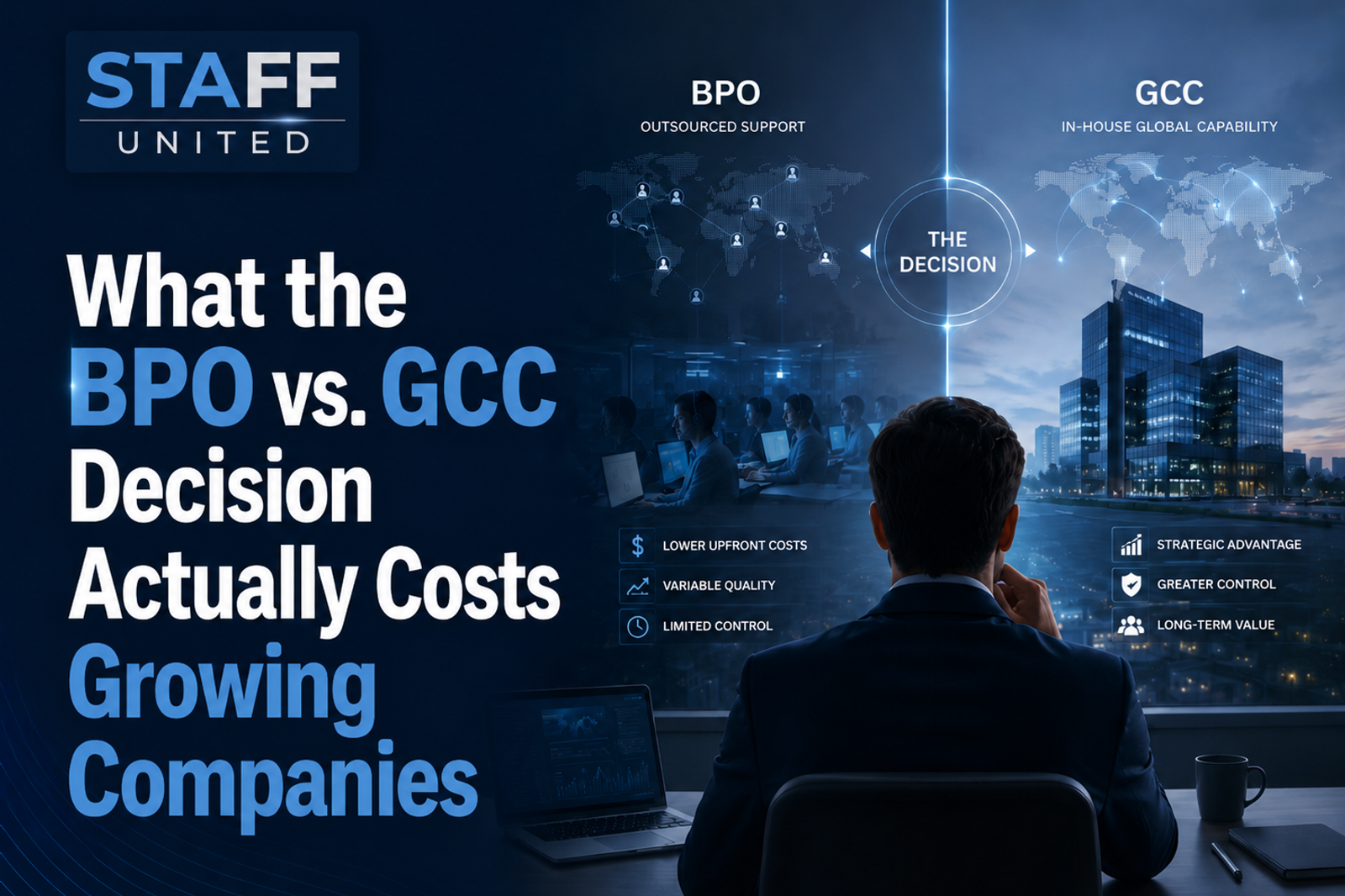
When leadership teams look to expand their execution capacity internationally, they are almost always presented with a binary choice. The traditional strategy looks exactly like this:
Option A: Traditional BPO (Business Process Outsourcing)
- The Good: Fast to set up and requires lower initial financial risk.
- The Bad: It often completely lacks integration, utilizes shared resources with high staff turnover, and forces you to constantly manage the resulting management gap.

Traditional BPO (Business Process Outsourcing)
Option B: GCC (Global Capability Centre)
- The Good: Deeply integrated into your business, enforcing your exact standards and your unique company culture.
- The Bad: Requires a complex legal entity setup in-country, heavy upfront office infrastructure investment, localized HR, payroll, compliance management, and full management overhead from day one.

GCC (Global Capability Centre)
Most growing companies analyze Option B and correctly decide they are simply not ready for that level of asset-locked risk and legal complexity.
So, by default, they choose Option A.
They sign a contract with a legacy BPO, accept the transactional limitations, and commit themselves to managing an exhausting management gap indefinitely.
The Hidden Cost of the Default Choice
When you default to a traditional BPO, you aren't just outsourcing tasks; you are inheriting an operational tax. Because the staff are shared or frequently rotated, you spend an unsustainable amount of time retraining agents, correcting errors, and policing quality. Your senior local team ends up babysitting the outsourcing provider just to ensure baseline brand standards are met.
You wanted to buy capacity, but you ended up buying a second job: managing the vendor.

On the other end of the spectrum, jumping straight into a GCC before you have scaled to thousands of employees is an administrative nightmare. Navigating foreign labor laws, setting up international entities, and managing cross-border compliance drains your executive focus away from your core product and your primary market.
The Third Option: Zero Legal Complexity, Maximum Integration
The gap between these two traditional choices isn't a dead zone—it is exactly where agile enterprises scale. Instead of accepting those systemic compromises, you can deploy a dedicated execution team that is locally recruited, fully employed, and operationally supported by a specialized partner.
This model creates a deeply integrated extension of your business where your team works directly within your internal systems and workflows. While a traditional BPO leaves you with low integration, high staff churn, and a massive management gap, this alternative provides dedicated talent and deep cultural integration.
Furthermore, unlike a heavy Global Capability Centre (GCC), it requires absolutely none of the steep upfront costs, complex legal entity setups, or foreign infrastructure management. By blending these two approaches, you secure the exact operational flexibility of a BPO and the deep integration of a GCC, while inheriting the systemic complexity of neither.
This Is the STAFF United Model
True operational scaling belongs to leaders who refuse to let archaic corporate structures dictate their growth velocity.
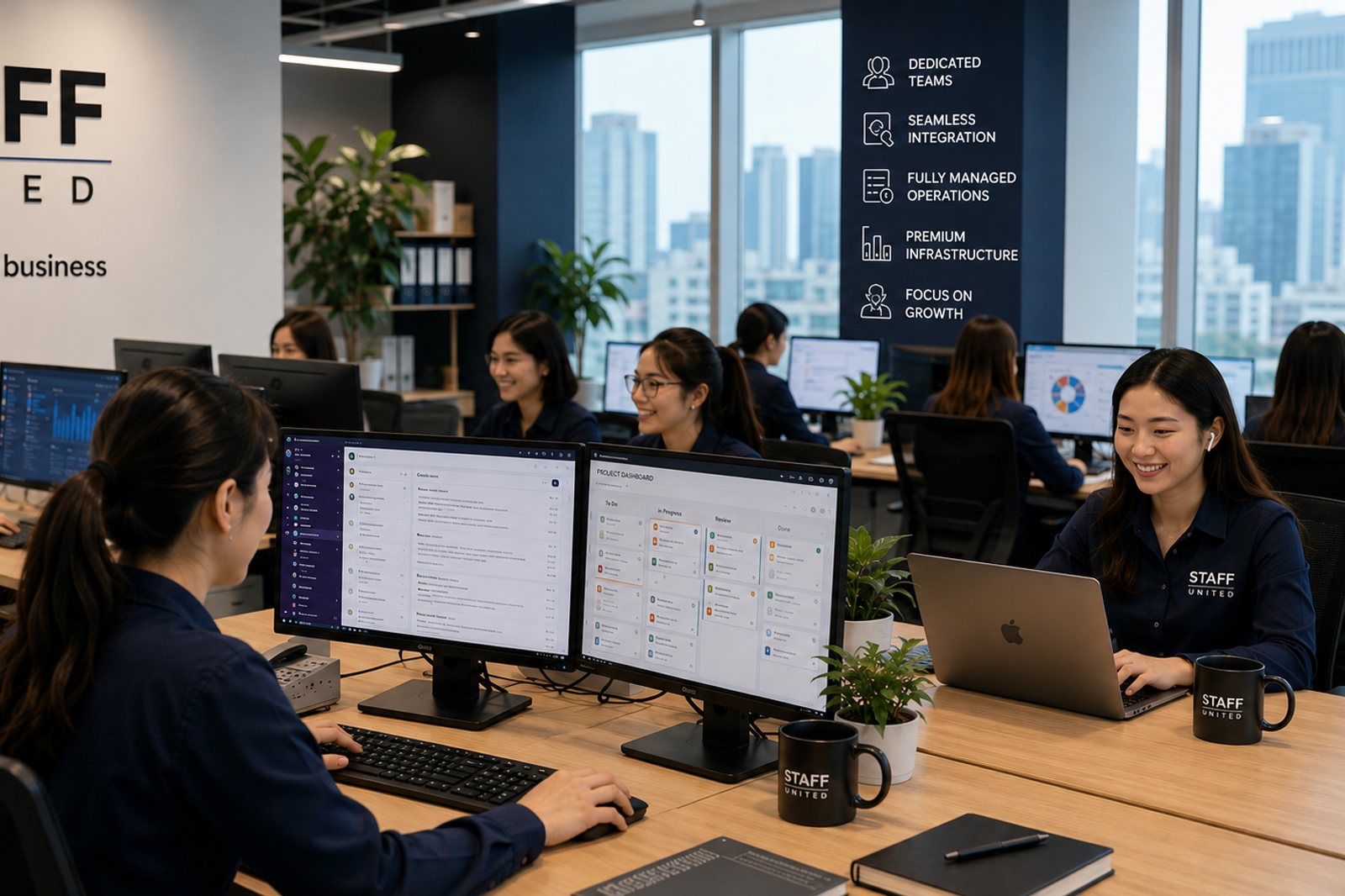
At STAFF United, we engineer dedicated execution teams out of Vietnam that function as a seamless extension of your native workflows. We handle the entire local employment framework, compliance, premium office infrastructure, and operational support. This leaves your team completely free to focus purely on high-level execution, production, and market expansion.
If your business is growing and your current structure wasn't built for the scale you are heading toward, you do not have to settle for the compromises of the past. The conversation is worth having.
👉 Begin your 5-minute Client Fast Track at staffunitedgroup.com/request-support and tell us what your business needs executed today.
Related Insights
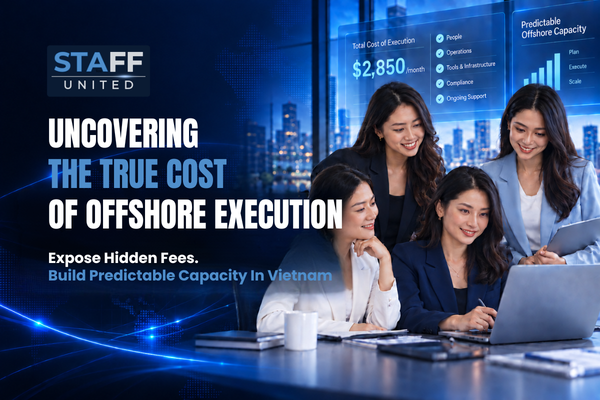
Uncovering the True Cost of Offshore Execution: Hourly Rates vs. Total Cost of Execution
How global operators evaluate financial transparency, eliminate hidden fees, and build predictable offshore capacity in Vietnam.
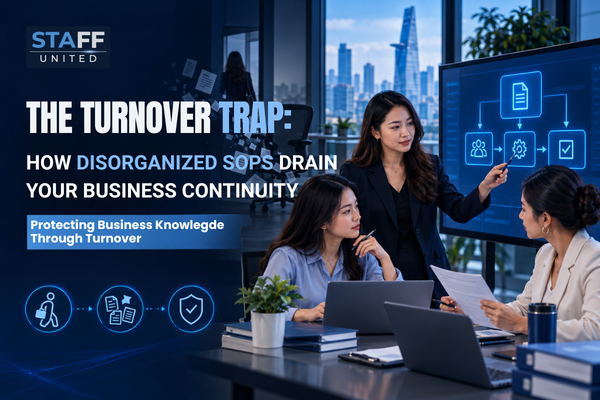
The Turnover Trap: How Disorganized SOPs Drain Your Business Continuity
Why traditional offshore models lose operational knowledge during team turnover—and how embedded process architecture protects your business.

Cultural Synergy in Global Teams: How Modern Vietnamese Professionals Master Executive Communication
How international founders overcome cultural friction, build direct feedback loops, and unlock proactive execution in Vietnam.