Vietnam vs. Colombia: Two Rising Offshore Markets, Two Very Different Strengths
Which execution destination actually fits your business—and why the answer depends on who you're building for.
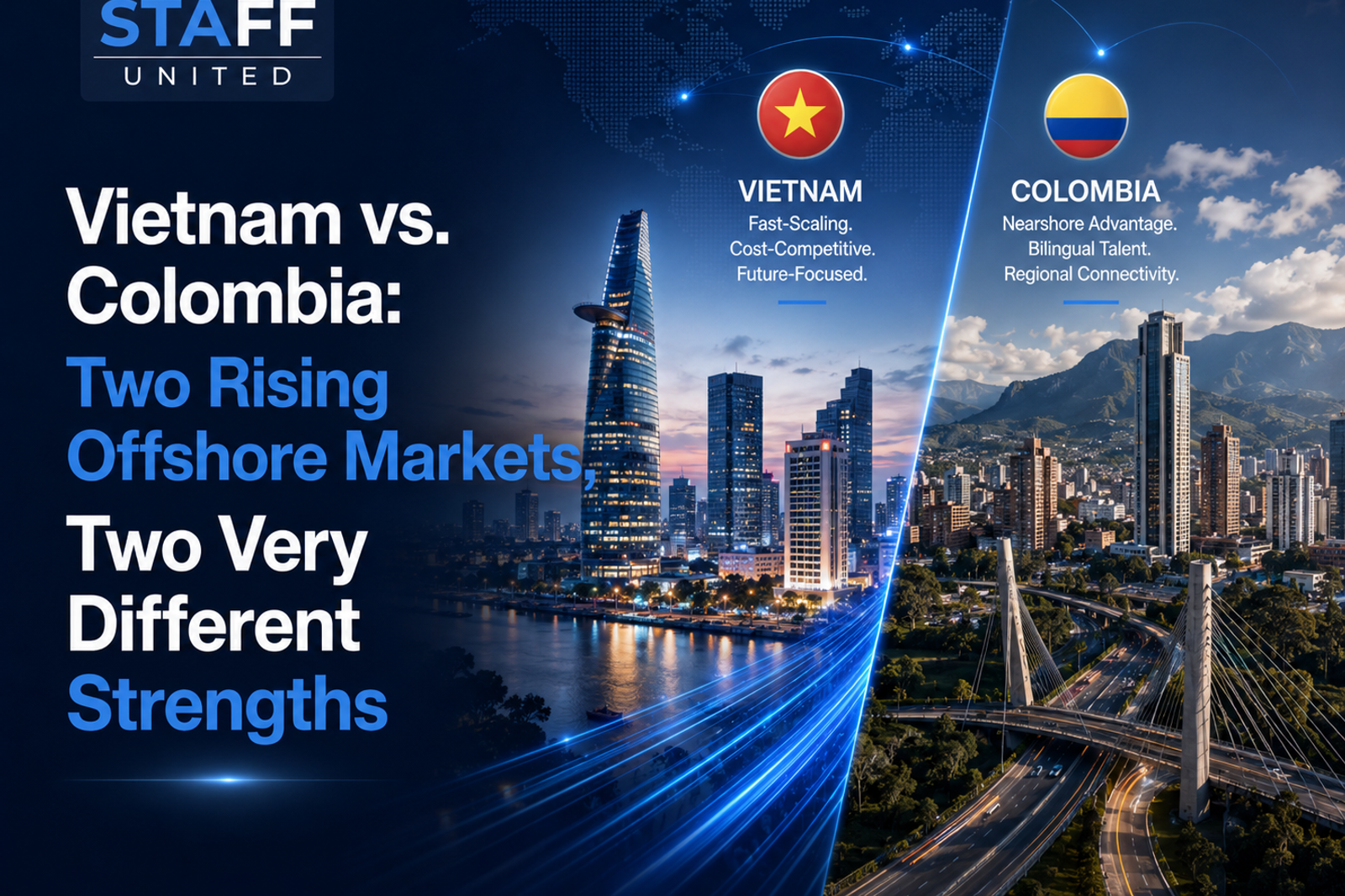
The global conversation about offshore execution has changed. It used to be dominated by India and the Philippines. Today, two newer markets are competing hard for the attention of founders and operators building remote execution teams: Vietnam and Colombia.
Both are growing fast. Both offer compelling talent at competitive cost. Both have attracted serious international business investment. And yet they are genuinely different markets—shaped by different geographies, different industries, different time zones, and different strengths.
This article is not a promotional piece for either country. It is a straight comparison of what each market actually offers, where each one excels, and how to think about the decision if you are a global founder or operator trying to choose.

The Headline Numbers
Before going deeper, it helps to understand the scale of what is happening in both markets.
- Vietnam's Economic Trajectory: Vietnam has become one of the fastest-growing offshore service markets in Asia. The BPO industry's export value is on track to hit $6 billion in 2025, aligning with governmental ambitions to elevate the sector's GDP contribution. The broader services economy is growing alongside it—Vietnam's GDP growth rate year-on-year reached 7.83% as of March 2026. On the IT side specifically, Vietnam's IT services market is expanding at roughly 11–17% annually, with Roland Berger estimating the IT sector will reach approximately $13 billion by 2026.
- Colombia's Latin American Momentum: Colombia is posting equally striking numbers on its side of the world. Colombia's BPO market has averaged 16%+ annual growth, making it the fastest-growing BPO sector in Latin America. On the technology side, Colombia's tech outsourcing sector is set to grow from $755 million in 2025 to $1.8 billion by 2029. Colombia is now ranked fifth among the world's best destinations for BPO operations according to the Offshore BPO Confidence Index.
Two markets. Both accelerating. Both attracting serious international interest. The question is not which one is "better" in the abstract—it is which one is better for your specific business.
Geography Is Strategy
The most important structural difference between Vietnam and Colombia is one that rarely gets discussed first: time zone.
Colombia (UTC-5)
Colombia sits at UTC-5, which aligns directly with US Eastern Time. With a strong bilingual workforce, modern infrastructure, and government support, Colombia is now handling tech support, knowledge processes, and back-office operations for global businesses. The proximity to North American business hours is not incidental—it is Colombia's single most powerful commercial advantage. For a US or Canadian company that needs real-time collaboration, live customer support, and same-meeting-time access, Colombia's time zone alignment is genuinely difficult to replicate.

Vietnam (UTC+7)

Vietnam sits at UTC+7, which means a 12-hour difference from the US East Coast and a natural alignment with clients in Australia, Japan, South Korea, Singapore, and increasingly Europe (where a morning workday in Ho Chi Minh City overlaps with early-afternoon Europe). For companies building 24/7 coverage models, Vietnam's time zone becomes an asset rather than a constraint—the team is active precisely when North American clients are sleeping.
The Operational Implication: If your primary clients are North American and real-time responsiveness is critical, Colombia has a structural advantage. If you are building for Australian, Asian, or European clients—or specifically want always-on coverage that continues while your home market rests—Vietnam is the more natural fit.
The Language Question
Both countries have made significant investments in English-language capability, but the nature and scope of that capability differs.
Colombia’s Verbal Fluency
Colombia has made English proficiency a national priority. About 1.6 million Colombians speak fluent English with a neutral accent, with Barranquilla being the first city in Colombia to mandate that public schools become 100% bilingual. Colombian English tends to carry a Latin American accent with North American cultural reference—which makes it particularly effective for US customer-facing roles, sales support, and voice-based client communication.
Vietnam’s Operational Execution
Vietnam's English proficiency has grown substantially within its professional class, particularly in Hanoi and Ho Chi Minh City, and particularly among younger professionals who have come through internationally oriented universities. The communication strength in Vietnam tends to show most clearly in written English, structured project communication, and operations-oriented roles—marketing coordination, content production, admin support, research, and process-driven execution. Voice-based English for US consumers is a less natural fit than Colombia's.
Industry Strengths
The two markets have developed real depth in different service categories.
Colombia's Depth

- Customer service and contact centre operations
- Sales support and lead qualification
- Back-office processing for US-market companies
- Tech support and IT helpdesk
- Knowledge process outsourcing with strong English delivery
Vietnam's Depth

- IT development and software engineering: Vietnam currently has approximately 500,000–560,000 IT professionals and adds roughly 55,000 new IT and software graduates each year.
- Operations and administration support
- Marketing execution and content production
- Finance coordination and accounting support
- Structured execution for global founders and SMEs
These are not hard lines—talented professionals exist across all categories in both countries. But when you are building a team that needs deep capability in a specific area, the depth of the talent pool matters. Colombia's BPO infrastructure has created a proven pipeline for customer-facing roles. Vietnam's education system and tech investment have built a pipeline for technical and operational execution.
The Cost Picture
Both markets offer significant cost advantages compared to the US, UK, or Australia—but at different price points for different skill levels.
- Colombia: The total employment cost of tech talent in Colombia is still around 54% lower than in the US, even with recruitment fees, benefits, and the 13th-month salary included. For customer service and BPO roles, the savings can reach 60–65%.
- Vietnam: Vietnam's cost structure is similarly competitive. Vietnamese IT professionals earn around $15–25 per hour in 2025—though for operational and administrative support roles, the cost advantage can be more pronounced. For businesses building structured execution teams rather than pure development teams, Vietnam often delivers more capacity per dollar for non-technical roles.
The cost comparison is genuinely close enough that it should not be the primary deciding factor. If the time zone, language profile, and industry strength align with your business need, the cost difference between the two markets is unlikely to be the variable that determines success.
Talent Depth vs. Talent Breadth
Colombia's outsourcing market is more mature in the BPO sense—there is an established ecosystem of providers, a trained workforce experienced in outsourcing workflows, and a recognised infrastructure in cities like Bogotá and Medellín. This maturity is a genuine advantage for companies that want to plug into an existing system.
Vietnam's professional services market is less mature as a formal outsourcing ecosystem—but it is growing faster and from a larger talent base. Vietnam has rapidly evolved from a low-cost outsourcing destination into a strategic technology partner for global businesses. The talent pool is younger on average, more likely to be building toward international work as a career aspiration rather than just a job, and—particularly in the female professional workforce—deeply motivated by the opportunity to work with global clients.
The distinction matters for founders building embedded execution teams rather than transactional outsourcing relationships. A team that is ambitious, motivated, and building toward long-term professional development with your company is a different operating asset from a trained but transactional BPO workforce.
What the Decision Actually Comes Down To
Rather than declare a winner—which would depend entirely on the business asking—here is a clearer decision framework:
Choose Colombia if:
- Your primary market is North America and real-time collaboration is non-negotiable.
- You need voice-strong English for customer-facing roles.
- You are building customer service, contact centre, or outbound sales operations.
- You want an established outsourcing ecosystem with proven BPO infrastructure.
Choose Vietnam if:
- Your clients are primarily in Asia-Pacific, Australia, Europe, or globally distributed.
- You need structured execution—operations, admin, marketing, finance coordination, content.
- You want always-on coverage that works while your home market is offline.
- You are building an embedded execution team rather than a transactional BPO relationship.
- You want a team that brings professional ambition to the partnership, not just task completion.
Consider both if:
- You are building 24/7 coverage and want Americas + Asia-Pacific presence.
- You need different capability types across different functions.
- You are large enough to run parallel teams in different time zones.
A Note on What Neither Market Guarantees
Here is the thing both markets' promotional materials tend to omit: access to a good talent market does not automatically produce a good execution team.
The quality of an offshore team—in Vietnam, Colombia, or anywhere else—depends on how the team is recruited, how it is structured, how workflows are built, what standards are set, and how continuity is maintained. A poorly structured team in a strong market will underperform a well-structured team in a less prominent one.
The market is the raw material. The structure is what determines the outcome.
Where STAFF United Fits Into This

STAFF United was built specifically around what Vietnam's professional talent market makes possible—and with a clear view of what makes offshore execution teams succeed or fail.
We are an all-women execution team based in Ho Chi Minh City, building structured operational support for global founders and businesses across marketing, operations, accounting and legal, sales support, and future expansion. By combining our localized talent base with comprehensive 24/7 global support, our 5-Core Support™ model delivers the continuous operational velocity that modern enterprises require. We do not offer transactional, task-based BPO relationships; we provide embedded, structured, and accountable execution that runs seamlessly around the clock without constant management overhead.
If Vietnam's profile fits your business—and especially if you need to serve clients across Asia-Pacific, Australia, and Europe while maintaining always-on operations that close the overnight gap—we would be glad to have a conversation about what that looks like in practice.
The Client Fast Track takes under five minutes. No lengthy brief required. Just tell us what you actually need.
👉 Start your Client Fast Track at staffunitedgroup.com/request-support
Related Insights

Uncovering the True Cost of Offshore Execution: Hourly Rates vs. Total Cost of Execution
How global operators evaluate financial transparency, eliminate hidden fees, and build predictable offshore capacity in Vietnam.

The Turnover Trap: How Disorganized SOPs Drain Your Business Continuity
Why traditional offshore models lose operational knowledge during team turnover—and how embedded process architecture protects your business.

Cultural Synergy in Global Teams: How Modern Vietnamese Professionals Master Executive Communication
How international founders overcome cultural friction, build direct feedback loops, and unlock proactive execution in Vietnam.