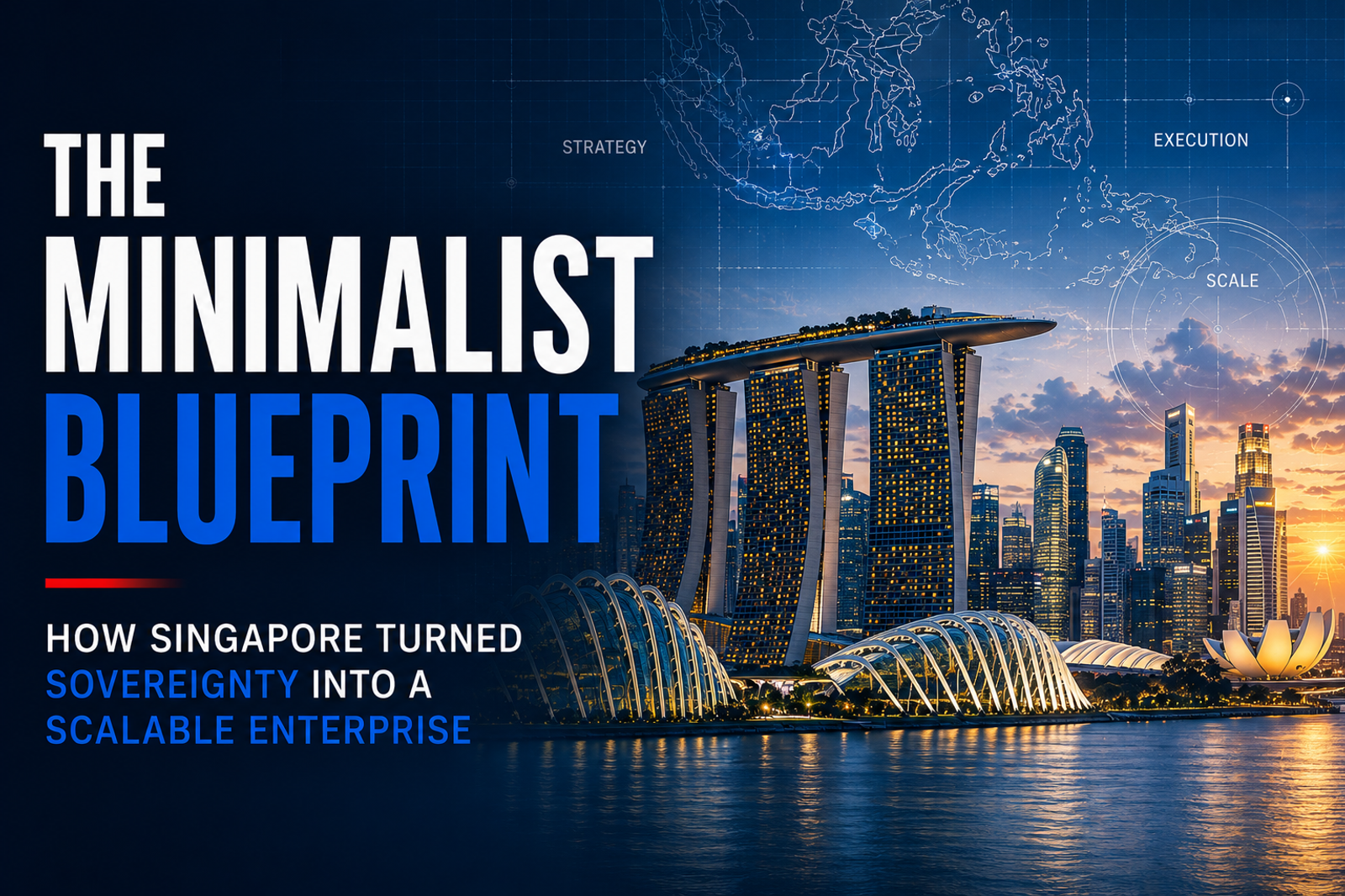
The Minimalist Blueprint: How Singapore Turned Sovereignty Into a Scalable Enterprise
If you stood on the shores of Singapore in August 1965, you would have been looking at a geopolitical anomaly that was never supposed to survive. Unlike Japan or South Korea, Singapore did not just lose its infrastructure or its capital—it lost its entire country
Ejected from the Malaysian Federation, the tiny island-state was suddenly cast adrift with no natural resources, no hinterland for agricultural supply, no domestic market, and a highly volatile, ethnically fractured population.
Yet, within a single generation, Singapore transformed from a high-risk tropical port into one of the most affluent, hyper-efficient financial and logistical hubs on the planet.
This wasn't a miracle of luck or international benevolence. Singapore looked at the post-war industrial playbooks of its Northeast Asian neighbors, stripped away all operational excess, and treated the entire nation-state as a high-performance corporate enterprise. It was an economic expansion built on a minimalist design philosophy: flawless efficiency, absolute structural clarity, and zero room for systemic friction.
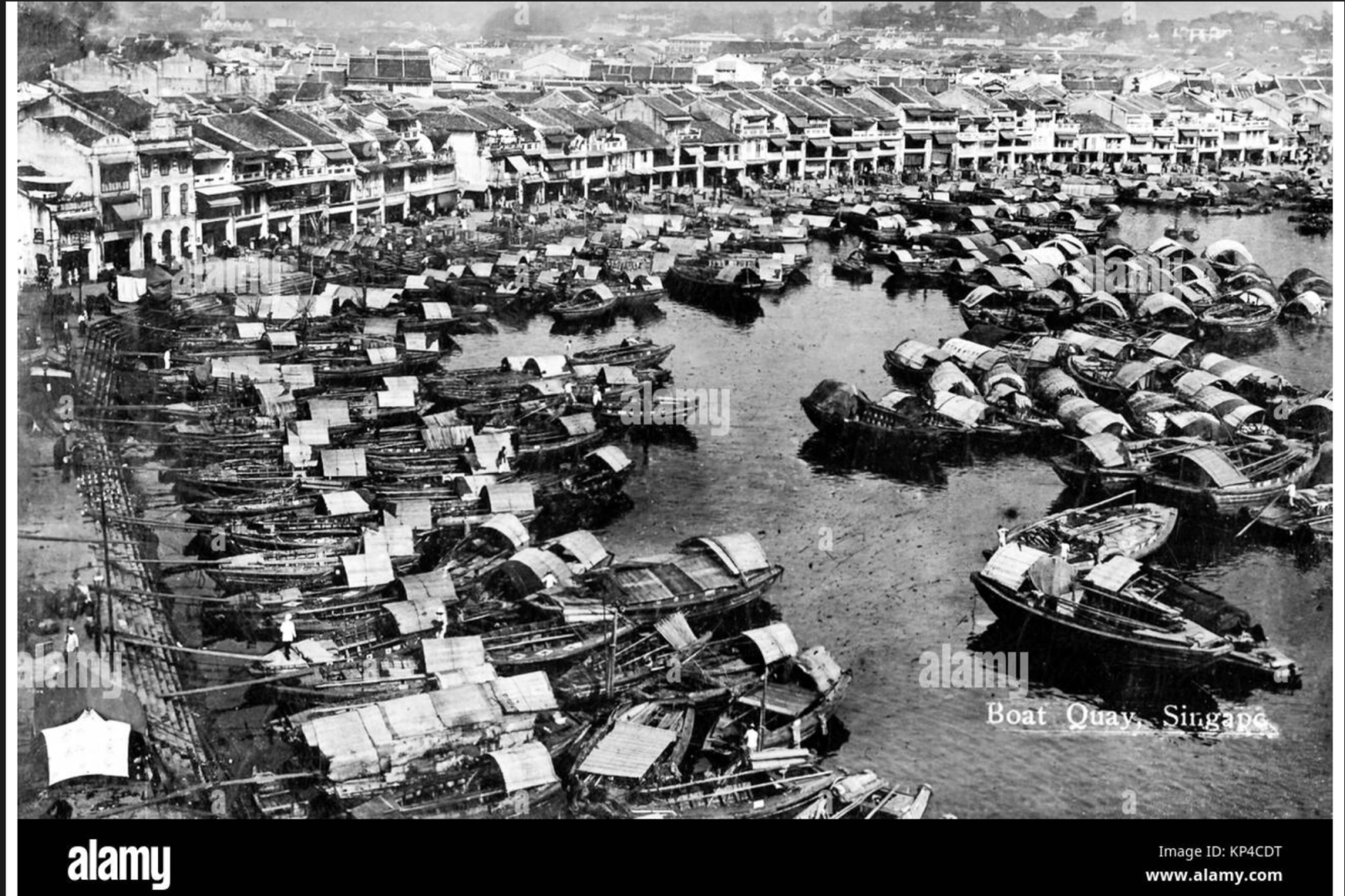
The reality of 1965: A cluttered, high-risk tropical trading port suddenly forced to navigate independence alone. Source: Archive Photos via Getty Images. Source: alamy.com
The Starting Point: A Nation With Nowhere to Grow
To understand the absolute velocity of Singapore’s scaling model, one must look directly at the sheer architectural constraints of 1965. The baseline was not zero; it was a structural crisis.
Singapore suffered from an absolute lack of natural capital, possessing no oil, no minerals, no agricultural land, and not even a self-sufficient supply of fresh drinking water, which forced it to rely entirely on pipelines from neighboring Malaysia. At the same time, the nation faced a defenseless port as the British military—which accounted for roughly 20% of Singapore’s gross domestic product (GDP) and thousands of local jobs—announced a complete withdrawal of its forces, leaving the tiny island economically exposed and militarily vulnerable. Compounding these issues was a severe unemployment crisis, with urban areas heavily plagued by massive overcrowding, sub-standard housing slums, and a jobless rate hovering near 14%.
The international consensus was clear: a city-state with no internal market and no natural resources could not survive as an independent country. But where the world saw a fatal lack of resources, Singapore’s leadership saw an opportunity to build a frictionless operational system.

There was a sharp increase in Singapore's population in the years immediately following the Japanese Occupation, and overcrowding was a major problem. (1950s). Source: National Museum of Singapore.
The Economic Levers: MNCs and Guided Free-Market Architecture
While Japan built its Keiretsu networks and South Korea engineered its family-owned Chaebols, Singapore realized it had no time to wait for domestic conglomerates to grow organically. Instead, it executed a radical, counter-intuitive strategy: it bypassed regional markets entirely and hooked its economy directly into Western Multi-National Corporations (MNCs).
The state didn’t leave this global integration to chance. Under the Economic Development Board (EDB), Singapore practiced a highly curated, premium form of guided capitalism.
Singapore pulled three specific, highly coordinated levers to attract global capital:
1. The Frictionless Investment Infrastructure
The government designated vast swathes of land—starting with the swampy wasteland of Jurong—and transformed them into fully serviced, plug-and-play industrial estates. MNCs could land in Singapore and have a fully functional factory operational in a matter of weeks, completely bypassing the bureaucratic friction common in developing nations.
2. The Clean-Sheet Legal and Tax System
Singapore recognized that capital flows toward absolute predictability. The state established an unyielding rule of law, strict intellectual property protections, and a transparent, low-corporate-tax framework. Corruption was not merely penalized; it was systematically engineered out of the culture by paying public officials competitive, market-rate corporate salaries.
3. The Sovereign Corporate Model
Rather than leaving infrastructure to private monopolies, the state created highly competitive, state-linked enterprises that operated with strict corporate discipline. Companies like Singapore Airlines, PSA International (ports), and Singtel were owned by the state’s investment arm, Temasek, but were mandated to compete globally on pure merit. If they failed to turn a profit, they were liquidated. No bailouts. No compromises.
Human Capital as Premium Infrastructure
Without a single drop of oil or gold, Singapore treated its population as its only sustainable asset. The national education and housing strategies were designed to turn raw human capital into an elite, highly reliable workforce.
To establish a universal bilingual operating system, the state mandated English as the primary language of administration and commerce while requiring students to learn their mother tongue, which instantly turned an entire generation into bilingual global professionals capable of interfacing seamlessly between Western capital and Asian supply chains. Simultaneously, the government closed the housing-equity loop through the Housing & Development Board (HDB) and the Central Provident Fund (CPF) by building high-quality, high-density public housing and allowing citizens to buy their homes using their mandatory state savings. By transforming a transient immigrant population into a nation of property owners, Singapore created an immediate, deeply rooted sense of national stability and collective pride.
What Made Singapore Different: Global Node Architecture
While Japan and South Korea scaled through massive domestic workforces and heavy industrial manufacturing, Singapore’s design was distinct: it focused entirely on global connectivity and velocity.
Where the Northeast Asian model relied on a large-scale domestic workforce and heavy physical factories as its primary resource, the Singapore node architecture prioritized global connectivity, high-end logistical ports, and premium financial networks. In terms of market strategy, Japan and Korea focused heavily on exporting locally manufactured finished consumer goods, whereas Singapore chose to serve as the ultimate frictionless regional headquarters for global entities. Finally, while the Northeast Asian scale engine was driven by massive industrial volume and continuous process iteration like Kaizen or Ppalli Ppalli, Singapore accelerated its growth through the rapid velocity of capital, absolute legal trust, and elite technical competence.
Japan and Korea were massive production engines. Singapore became the ultimate global operating system—the premium interface through which global money, goods, and talent entered Asia safely.
The Pattern Underneath It All
When you strip away the geography, Singapore utilized the exact same universal progression that powered its predecessors, executed with clinical precision:
- Clarity: Total focus on one goal—absolute economic survival through global relevance.
- Structure: Eradicating red tape, building premium industrial zones, and adopting English as a commercial standard.
- Consistent Execution: Delivering flawless logistical uptime, unyielding legal predictability, and zero-tolerance anti-corruption day in and day out.
- Trust: Capital markets realized that Singapore was the most reliable, secure vault and port in the region.
- Scale: Once trust was cemented, global wealth, tech talent, and logistical trade scaled automatically into the country.
Three countries. Three distinct frameworks. The exact same underlying system architecture.
Now look southeast toward the developing coastlines of Southeast Asia. Something is beginning.
Related Insights
Uncovering the True Cost of Offshore Execution: Hourly Rates vs. Total Cost of Execution
How global operators evaluate financial transparency, eliminate hidden fees, and build predictable offshore capacity in Vietnam.
The Turnover Trap: How Disorganized SOPs Drain Your Business Continuity
Why traditional offshore models lose operational knowledge during team turnover—and how embedded process architecture protects your business.

Cultural Synergy in Global Teams: How Modern Vietnamese Professionals Master Executive Communication
How international founders overcome cultural friction, build direct feedback loops, and unlock proactive execution in Vietnam.