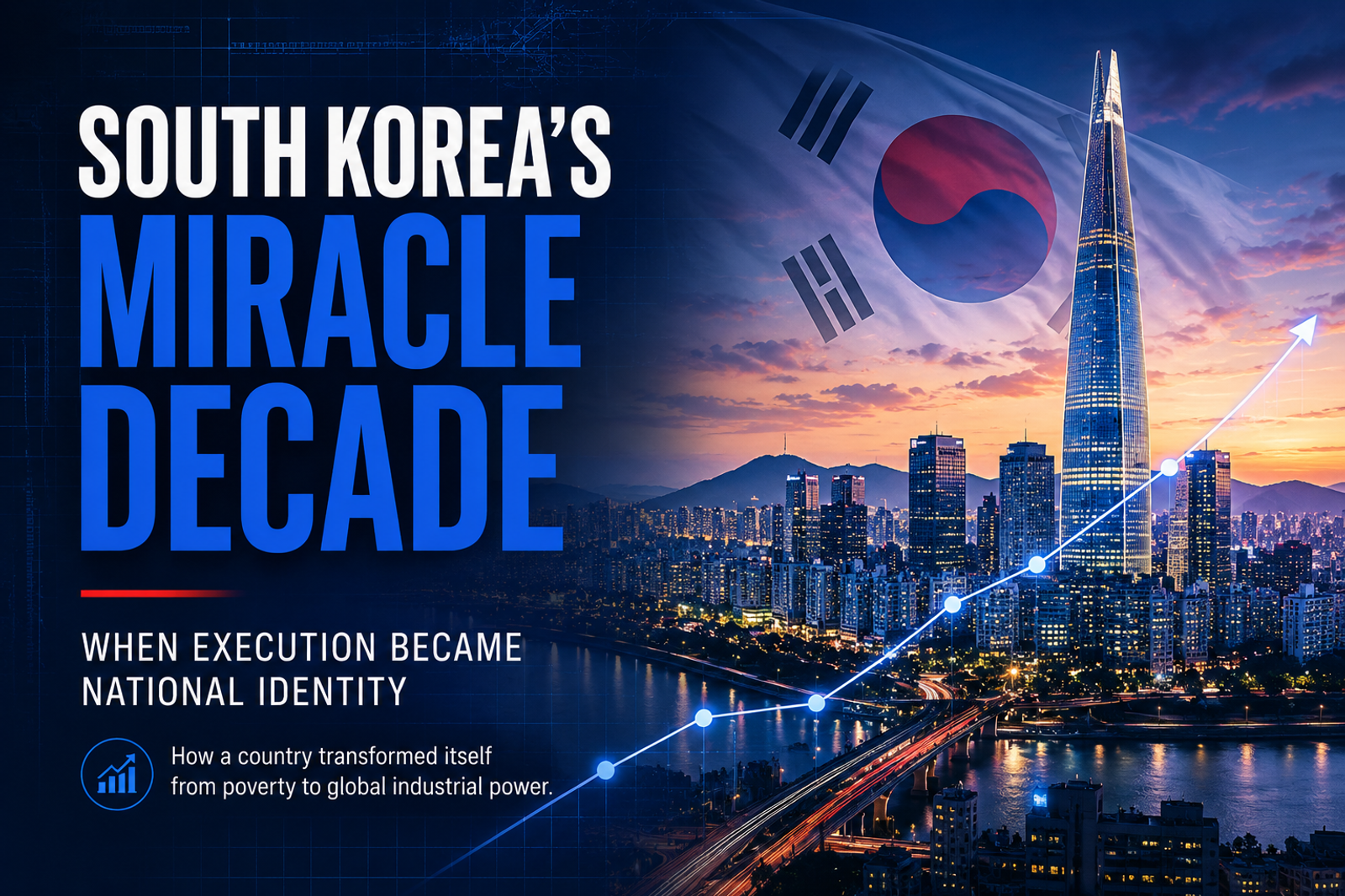
South Korea's Miracle Decade: When Execution Became National Identity
Many economists attempt to group South Korea’s rise with Japan’s post-war recovery. But South Korea did not simply copy the Japanese playbook. It did something far more radical: it compressed the development timeline to a degree never before seen in human history, turning ppalli ppalli (hurry, hurry) from a frantic cultural trait into a lethal macroeconomic weapon. It made execution a culture, not just a policy.
If you stood in Seoul in the winter of 1953, you would not be looking at a future global technology hub or a cultural superpower. You would be looking at a landscape of absolute desperation. The Korean War had just concluded in a bitter stalemate, leaving the Korean Peninsula physically, socially, and economically shattered. The country had no natural resources, no heavy industry, and no meaningful financial capital.
Yet, by the late 1980s, South Korea had engineered what is now universally known as the Miracle on the Han River. It didn't just rebuild; it transformed itself into a dominant global exporter of steel, ships, automobiles, and semiconductors.
The Starting Point: Korea in 1953 Post-War
To appreciate the sheer velocity of South Korea's industrialization, one must first look directly at the absolute baseline of 1953. The country was not merely starting from scratch; it was trapped in a deep, seemingly inescapable well of poverty.
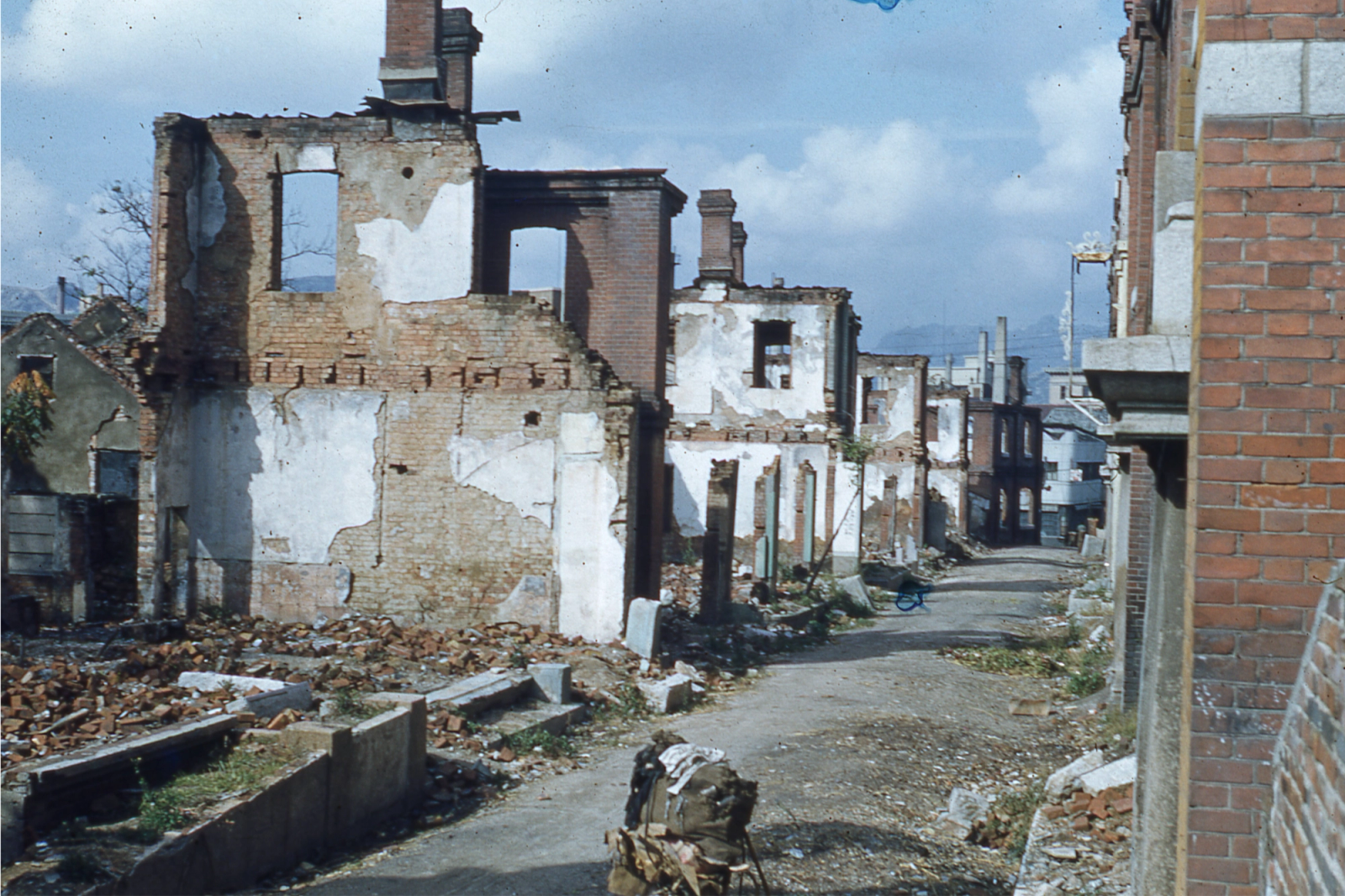
Seoul ruins 1953 historical photo destruction. Source: theworld.org
- The GDP Disparity: Following the armistice, South Korea's per capita GDP sat at less than $100 USD. To put that into perspective, its economic output was significantly lower than that of contemporary resource-rich African nations like Ghana and Gabon.
- Industrial Decapitation: The geopolitical partition left the peninsula deeply unbalanced. The vast majority of the region's mineral wealth, heavy industrial plants, and electrical grids were located in North Korea. South Korea was left as an isolated, agrarian remnant with an overpopulated, displaced citizenry to feed.
- Infrastructure Obliteration: Three years of intense, mobile warfare had systematically leveled more than two-thirds of the nation's physical infrastructure. Housing, roads, bridges, and railways were completely non-functional.
International observers at the time classified South Korea as a permanent basket case—a country entirely dependent on foreign humanitarian aid just to survive. The world saw a tragic casualty of the Cold War. They did not see an emerging economic titan.
Park Chung-hee’s Industrial Policy: Chaebols as Execution Vehicles
In 1961, General Park Chung-hee assumed control of the state and immediately established a radical, highly centralized command-and-control economic architecture. Park understood that standard free-market capitalism was too slow to bridge a century-long developmental gap.
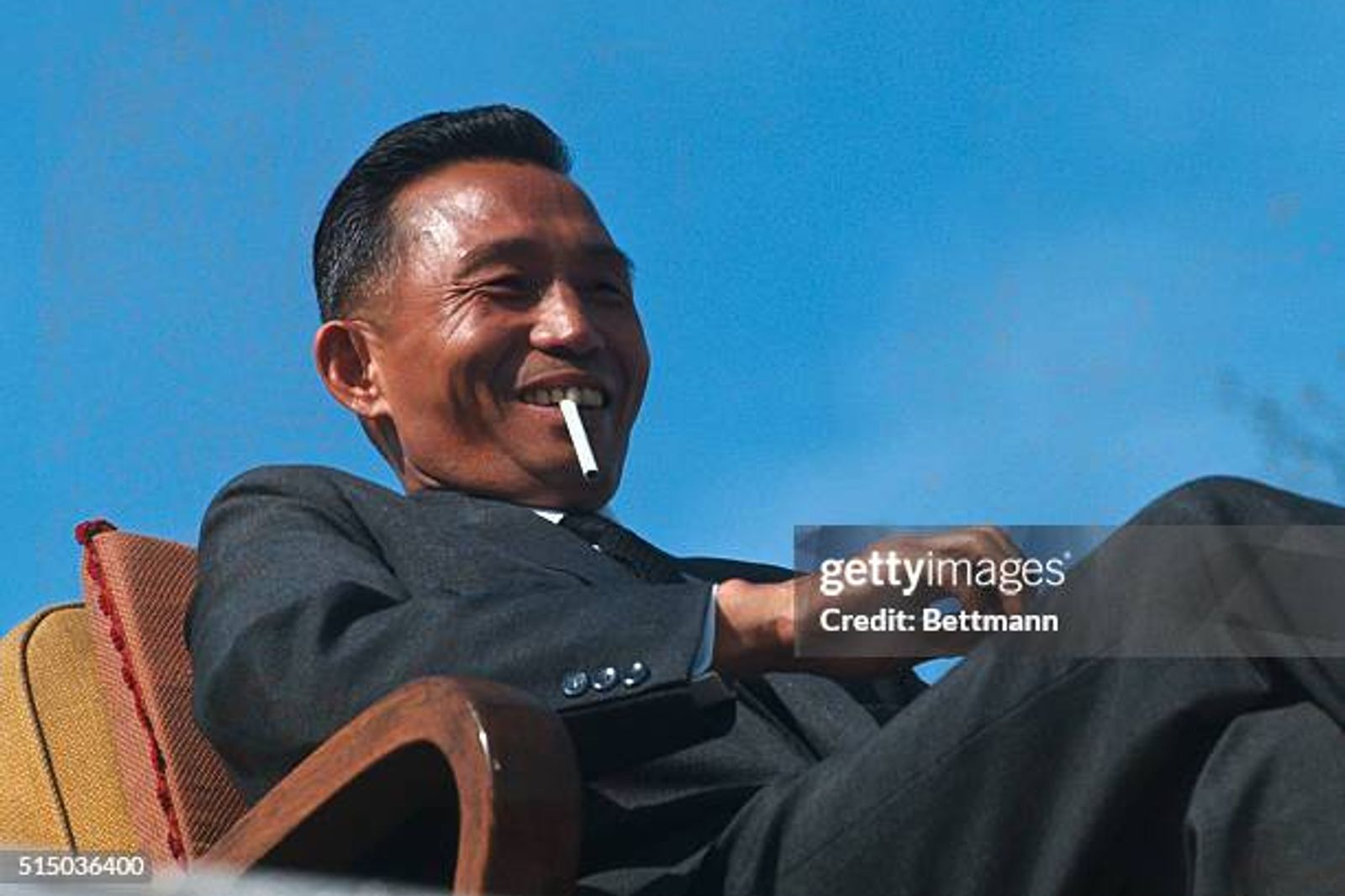
A rare candid moment of South Korean President Park Chung-hee during his tenure in the 1960s. Source: Bettmann / Bettmann via Getty Images
His solution was to forge a tight, highly disciplined alliance between the authoritarian state and a select group of family-owned trading enterprises. These enterprises were engineered to become the Chaebols (massive conglomerates like Samsung, Hyundai, Lucky-Goldstar [LG], and Daewoo).
Unlike traditional Western corporations or even Japanese conglomerates, the Chaebols were not built to operate as independent commercial entities. They were mobilized to function as tactical execution vehicles for national policy.
The state operated as a rigorous corporate headquarters, while the Chaebols functioned as the operating divisions. The mechanics of this relationship were brutal, clear, and transactional:
- State-Controlled Credit Allocation: Park nationalized the entire banking system. If a Chaebol alignment followed the state’s industrial roadmap, it was rewarded with massive, low-interest loans and exclusive import monopolies.
- The Export Quota Discipline: Financial favors were strictly tied to global export performance. If a Chaebol met its state-mandated export targets, its credit lines were expanded. If it failed, its access to capital was cut off overnight, exposing it to immediate bankruptcy.
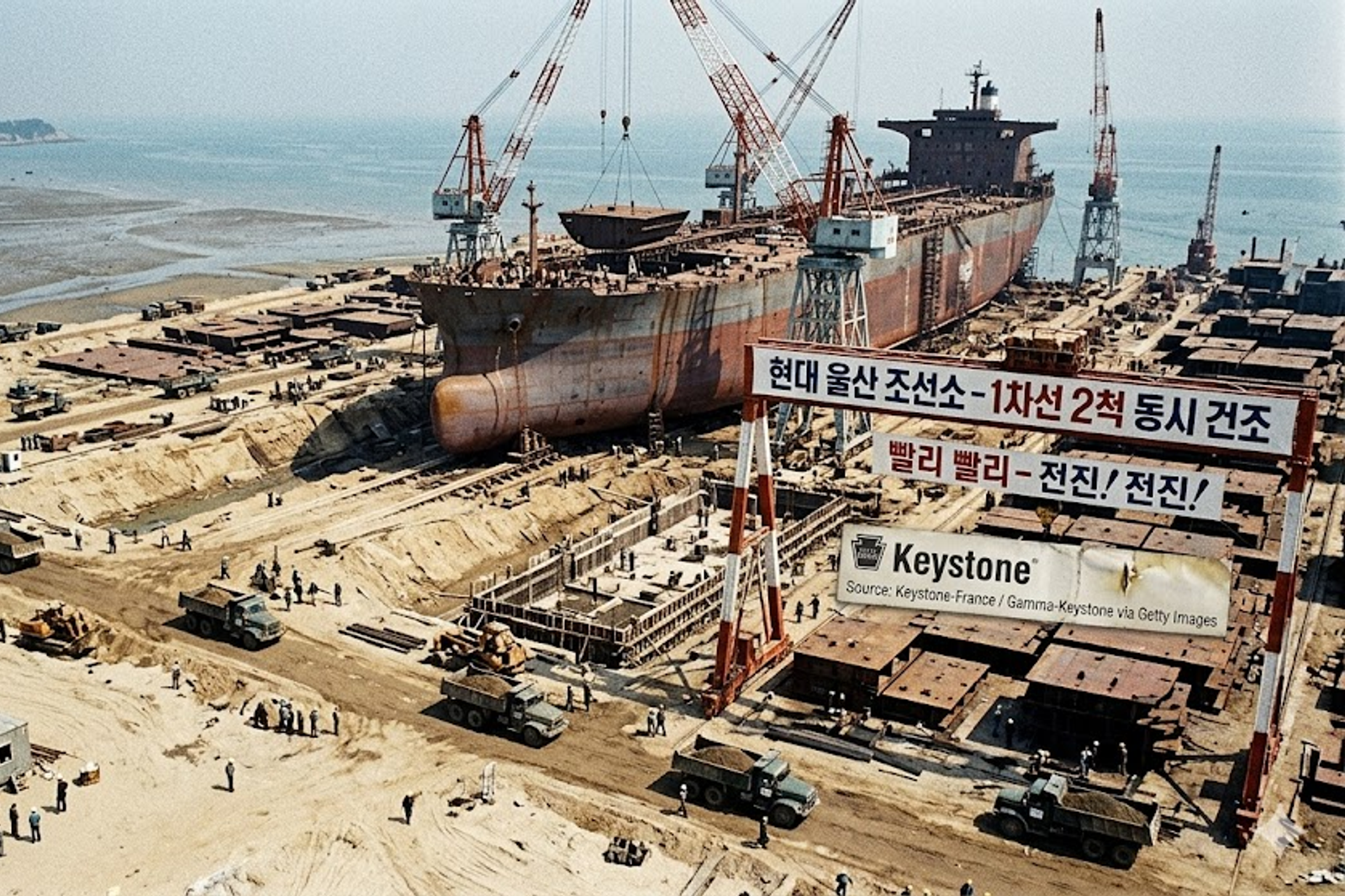
Through this high-stakes discipline, the state pushed resource-poor trading firms into capital-intensive heavy industries. Hyundai, a construction company, was told to build a world-class shipyard without any prior experience. Samsung, a sugar and textile trader, was pushed directly into electronics. They had no choice but to execute at scale. Failure was treated as a form of national treason.
Education as Infrastructure: Engineering Human Capital
While physical factories were being constructed, the South Korean state was quietly building its most potent long-term weapon: an intensely educated, fiercely competitive workforce. South Korea realized early on that because it possessed zero natural resources, its citizens had to become its primary economic engine.
The state didn’t treat education as a social luxury or a personal pursuit; it treated education as primary national infrastructure.
- The Literacy Surge: In 1945, the domestic literacy rate hovered at a dismal 22%. Through massive, state-directed primary and secondary school rollouts, South Korea achieved a staggering 97% literacy rate within less than two decades.
- Technical Prioritization: Higher education curricula were heavily aligned with macroeconomic industrial needs. The government funneled immense resources into technical high schools and specialized engineering universities, intentionally starving abstract humanities departments to oversupply heavy industries with practical, highly disciplined technical talent.
- The Meritocratic Crucible: The national examination system was engineered to be a brutal, high-stakes meritocracy. Scoring well became the singular path to social mobility, embedding a fierce culture of hyper-competition, intellectual stamina, and obsessive work ethic into generations of young Koreans.
What Made Korea Different From Japan: Speed and Intensity
It is easy to look at the broad strokes of South Korea’s industrial strategy and conclude that it was simply a carbon copy of Japan's post-war recovery. Both utilized state-directed credit, both prioritized export-led manufacturing, and both suppressed domestic consumption to protect local industries.
However, looking closer reveals a fundamental difference in speed, intensity, and compressed timelines when comparing the specific execution mechanics of these two economic expansions:
- The Developmental Trajectory: While Japan experienced a gradual, evolutionary economic ascent over 50 to 60 years by building directly upon its existing pre-war heavy industrial foundations, South Korea executed a revolutionary, high-velocity leap—compressing the transition from a low-tech agrarian economy to an advanced technology powerhouse into less than 30 years.
- The Corporate Architecture: Japan relied on the Keiretsu system, which consisted of decentralized corporate networks clustered around core alliance banks that operated through long-term corporate consensus. In contrast, South Korea engineered the Chaebol system, deploying hyper-centralized, military-style corporate command structures under the absolute personal control of their founders.
- The Execution Cadence: Japan’s operational framework centered on a methodical, highly structured process optimization model (Kaizen) that prioritized continuous quality iteration. South Korea rejected this slower cadence, instead utilizing a high-velocity, aggressive mobilization of its workforce (Ppalli Ppalli) that prioritized sheer speed and immediate global market capture.
Japan moved with a steady, institutional momentum. South Korea, operating under constant existential threat from the North, moved with frantic, military urgency.
When Hyundai set out to build its historic Ulsan Shipyard, it did not wait to design the facility, train the workers, and construct the berths sequentially. Instead, it famously sold ships to European buyers using nothing but a blueprint of a generic ship and a photo of an empty beach. They built the shipyard and the first cargo ships simultaneously.
This wasn’t just business management; it was high-risk combat execution mapped onto global commerce.
The Cultural Operating System: Pride, Shame, and Geunseong
Just as Japan activated its Meiji-era institutional values, South Korea unlocked a powerful, deeply historical cultural operating system to fuel its high-velocity execution loop. This system relied on three primary emotional and psychological pillars:
1. Collective Pride and Geunseong
The Korean people possessed an underlying cultural trait known as geunseong (근성)—a fierce, unyielding grit and stubborn doggedness in the face of impossible odds. After decades of colonial occupation and a devastating war, the population channeled this collective trauma into a burning desire for national self-assertion. Work was no longer just a means to secure a paycheck; it was an act of national defiance.
2. Shame as Quality Control
Within the tight-knit, collectivist framework of Korean society, failure did not just affect the individual—it brought profound shame upon the family, the corporation, and the state. This intense social pressure functioned as a relentless, self-regulating quality control mechanism. Workers routinely put in 14-hour days, six days a week, demanding absolute perfection from themselves and their peers to avoid the devastating social stigma of letting the group down.
3. Relentless Collective Mobilization
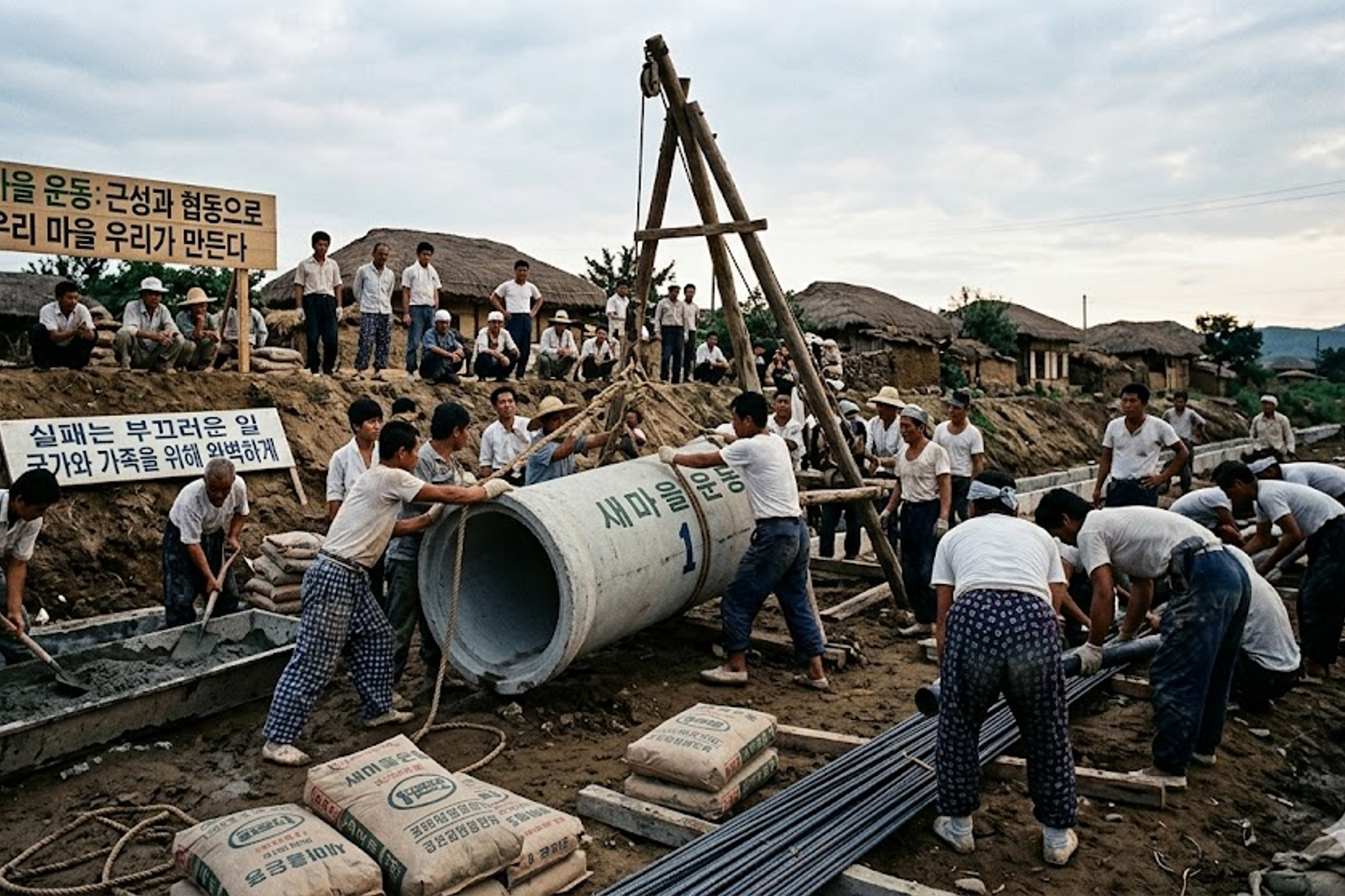
This psychological architecture was perfectly captured by the state-sponsored Saemaul Undong (New Village Movement) launched in 1970. The government provided rural villages with raw materials like cement and steel for free, but left it entirely to the villagers to self-organize, build modern infrastructure, and optimize their agricultural output. The movement ignited a powerful spirit of self-reliance and community-led competition, transforming the rural mindset from passive survival to aggressive, collaborative modernization.
The Universal Blueprint
When you step back from the specific historical timelines of the East Asian economic expansions, the underlying architectural framework becomes completely clear. The playbook does not change; only the execution cadence does.
Japan proved that a completely flattened nation could engineer global dominance by establishing absolute clarity of purpose and building rigid, protective structural networks. South Korea looked directly at that architecture, stripped away the evolutionary timelines, and proved that a nation could achieve the exact same scale of development in half the time by cranking the execution speed to its absolute limit.
Two countries. Two distinct miracles. The exact same underlying systemic architecture.
Now look southeast toward the developing coastlines of Southeast Asia. Something is beginning.
Next post explores how Singapore adapted this blueprint to turn its tiny island into a scalable corporate state?
Related Insights
Uncovering the True Cost of Offshore Execution: Hourly Rates vs. Total Cost of Execution
How global operators evaluate financial transparency, eliminate hidden fees, and build predictable offshore capacity in Vietnam.

The Turnover Trap: How Disorganized SOPs Drain Your Business Continuity
Why traditional offshore models lose operational knowledge during team turnover—and how embedded process architecture protects your business.

Cultural Synergy in Global Teams: How Modern Vietnamese Professionals Master Executive Communication
How international founders overcome cultural friction, build direct feedback loops, and unlock proactive execution in Vietnam.