Freelancers vs. Agencies vs. Embedded Teams: The Framework Founders Need
When a high-growth founder or a mid-market enterprise hits an operational bottleneck, the immediate reaction is always the same: we need more execution capacity. Whether your customer relationships are stalling, your accounting pipelines are lagging, or your marketing campaigns are falling behind schedule, the pressure to add headcount is unrelenting.
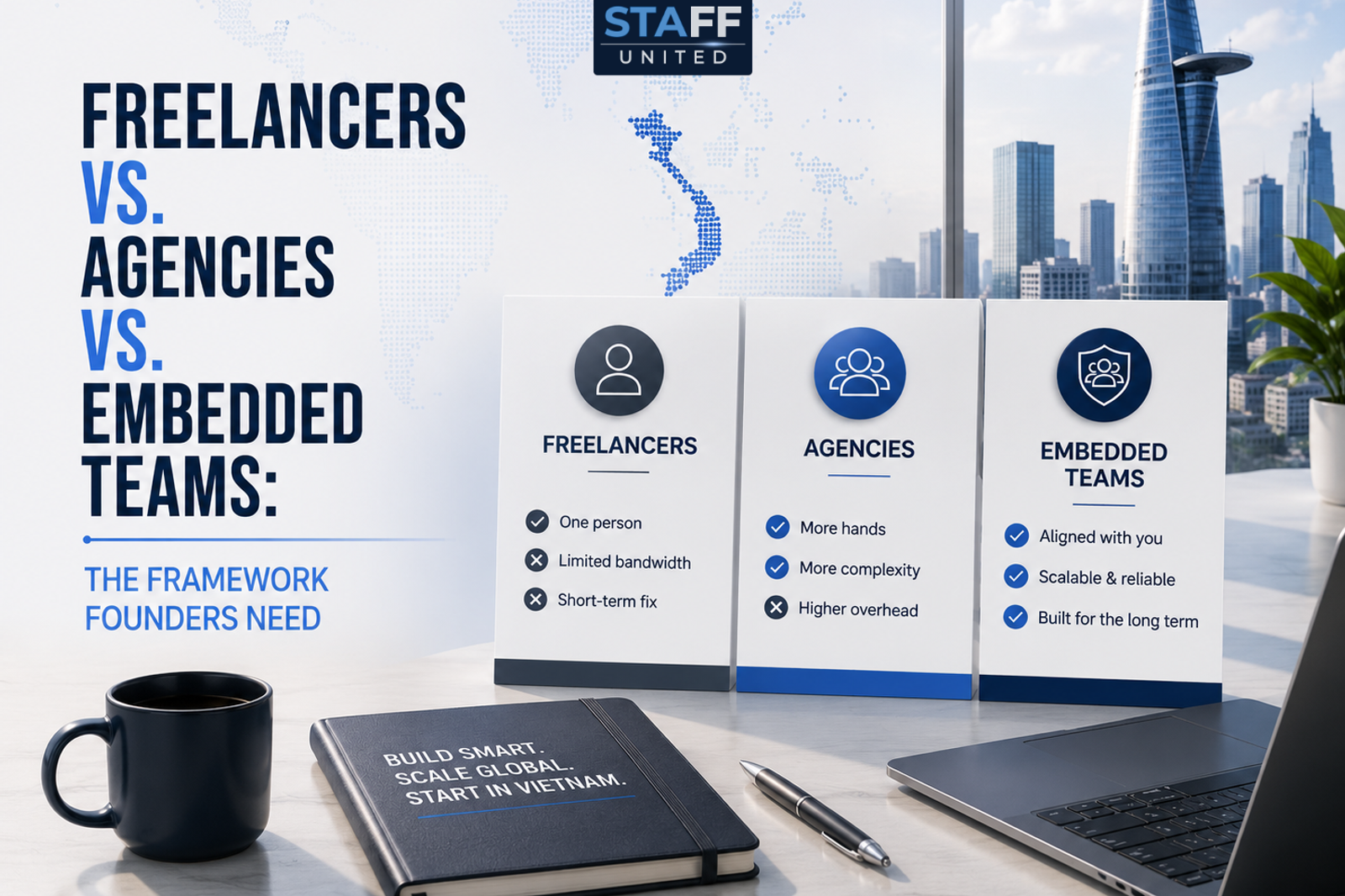
However, the biggest operational mistake leadership teams make isn't hiring too late; it is choosing the wrong structural vehicle for growth.
Establishing the wrong partnership model creates massive systemic friction, introduces expensive communication gaps, and drains executive focus. To scale a modern corporate infrastructure smoothly, you must understand the clear boundaries between the three primary methods of acquiring operational support.
1. There Are Three Ways to Build Operational Capacity. Most Businesses Pick the Wrong One.
Most organizations scale their departments through chaotic, reactive hiring rather than intentional system design. When tasks pile up, they default to familiar legacy paths without weighing the long-term impact on their corporate infrastructure.
True efficiency requires matching the nature of your workload to the exact organizational structure built to handle it.
If you attempt to run permanent administrative networks using temporary contractors, or if you hire high-overhead firms to run stable, daily workflows, your processes will inevitably buckle under the pressure. Resolving this issue requires a clinical evaluation of the market's three primary delivery vehicles: freelancers, agencies, and embedded execution teams.
2. Freelancers: Low Structure, High Management Burden
Freelancers are an exceptional tool when utilized for the exact purpose they were designed for: isolated, one-off project deliverables that require a highly specific, short-term technical skill.
The ideal use case includes designing a standalone product logo, writing an isolated piece of legal counsel, or configuring a specific API integration script.
However, this model provides the absolute lowest level of organizational structure. Freelancers offer zero long-term continuity because they manage their own independent client pipelines, causing their availability to fluctuate wildly and leaving you with no baseline retention of internal institutional knowledge. Furthermore, the management burden remains entirely on your shoulders; you must personally coordinate their timelines, audit their daily output, and bridge the communication gaps, making this model incredibly expensive to manage at scale.
3. Agencies: Campaign-Based and Project-Scoped
Traditional agencies are structured to deliver heavy, strategic creative lift or specialized consulting frameworks over a clearly defined, project-scoped timeline.

The ideal use case involves executing a complete multi-channel brand overhaul, launching an intensive quarterly advertising campaign, or auditing national compliance structures.
While agencies provide their own internal management layers, they operate on a rigid project scope that naturally isolates them from your daily team culture. This model is notoriously costly, frequently requiring premium monthly retainers that drain capital away from your core operations. Most importantly, agencies have no ownership of your ongoing, day-to-day operations. Once the specified project timeline concludes or the campaign wrap-up report is delivered, their team moves on to other accounts, leaving your internal staff to handle the complex daily upkeep and execution.
4. Embedded Execution Teams: Built for Systemic Scale
Embedded execution teams represent a fundamental shift in how global companies manage their core business infrastructure. Instead of sourcing detached transactional resources, you integrate a highly structured, dedicated unit straight into your existing digital environment.

This model is built specifically for long-term operational continuity, absolute outcome ownership, and seamless scalability. An embedded team operates as a direct, synchronized extension of your core office, taking over vital administrative zones like strategic operations, backend sales support, accounting, focused marketing, and future infrastructure expansion. They adopt your internal communication habits, master your proprietary toolsets, and retain critical institutional knowledge within your corporate balance sheet from day one.
5. The Decision Framework: 3 Questions to Ask Before Choosing
To prevent systemic friction and protect your organizational velocity, route your next hiring decision through this clinical three-part framework before signing a single contract:
Question 1: Is this task a temporary project or a permanent operational function?
If the workflow has a definitive end date, deploy a freelancer or an agency. If the task must repeat with absolute predictability every week for the next three years, it requires an embedded execution framework.
Question 2: Who will bear the daily management and quality-assurance burden?
If your executive team has the open bandwidth to micro-manage daily task handoffs, independent contractors can suffice. If you require a self-governing unit that manages its own internal quality control and output reporting, you must use an embedded team.
Question 3: How critical is it to retain institutional knowledge within the company?
When a freelancer leaves, their understanding of your system design, customer nuances, and internal playbooks leaves with them. If your business requires deep, compounding context to maintain structural stability, an embedded partnership is mandatory.
6. The Missing Category: Finding Your True Execution Partner
The missing category in modern scaling strategy is that most businesses discover embedded execution teams only after the other two legacy models have completely failed them.
Founders frequently spend years cycling through unreliable freelance networks or burning through capital on detached agencies before realizing that what they actually needed was a permanent, structural extension of their company. True organizational scale belongs to those who see this distinction early, engineering systemic friction out of the equation from the very beginning.
There is one team in Vietnam that was built specifically around the embedded execution model — and nothing else. That's what the next post is about.
Related Insights

Uncovering the True Cost of Offshore Execution: Hourly Rates vs. Total Cost of Execution
How global operators evaluate financial transparency, eliminate hidden fees, and build predictable offshore capacity in Vietnam.
The Turnover Trap: How Disorganized SOPs Drain Your Business Continuity
Why traditional offshore models lose operational knowledge during team turnover—and how embedded process architecture protects your business.

Cultural Synergy in Global Teams: How Modern Vietnamese Professionals Master Executive Communication
How international founders overcome cultural friction, build direct feedback loops, and unlock proactive execution in Vietnam.